
EDIT (9/8): I have significantly culled down Section 3.3 in its evaluation of the photographic evidence. This is after learning Mark Grant’s objections in his initial paper may not be reflective of the new lines of argumentation he’ll be making soon. So, as to not misrepresent him, I have removed those summaries for the time being. I’ll leave any subsequent discussion for him, Muse and Dalleur to work out and provide an update either here or in another post.
“The greatest enemy of any one of our truths may be the rest of our truths.” - William James1.
Introduction
There’s been a surprising resurgence of ‘miracle claims’ in the discourse recently, which have been used to argue for the plausibility of Catholicism in particular. Ethan Muse, a PhD candidate at the Rutgers University Philosophy department, has been at the forefront of this surge, providing robust defenses of these historically salient, yet overlooked, events: eucharistic miracles, Marian apparitions, incorruptibility, stigmata and miraculous healings. Muse’s strategy is to appeal to a cumulative inference to the best explanation, a tactic that stipulates the ‘Standard Catholic Hypothesis’ (SCH) is able to not only explain but also predict a large number of mutually reinforcing facts. A ‘Naturalistic Hypothesis’ (NH), meanwhile, would have to invoke several separate, independently unlikely explanations. All the evidence that co-reports in a certain state of affairs, as a result, is described as a “confluence of anomalies,” which would not be parsimoniously accounted for under the NH. Intuitively, a string of coincidences is not as convincing or potent as a single explanation.
For instance, imagine that a detective is called to the scene of a crime. He finds a corpse, a scattered knife with fingerprints belonging to the housemaid, a lack of an alibi for said housemaid and splatters of blood on the hem of her dress. Sure, it’s logically possible that the now deceased man tripped and fell down the stairs, the housemaid had handled the knife three days before this incident and accidentally let it slip while doing her chores, she fell sick the day previously and stayed boarded up in her room without encountering another person, and she also pricked herself while sewing later that night, hastily wiping the blood on her dress. Now compare this to the detective simply coming to the conclusion that the girl killed this man. Which one is prima facie, at least, more attractive? Similarly, Muse argues that the SCH is analogous to the more parsimonious conclusion.²
Such an inference is perfectly valid, and perhaps even sound, of course. But there are two methodological considerations here: (1) The Independence Criterion and (2) the Total Evidence Criterion.⁶ From a more meta-standpoint, I will argue Muse fails to satisfy either criterion, thus weakening his abductive case and rendering it disanalogous to the detective example. The miracle in question here is the Miracle of Fátima (or the Miracle of the Sun). Three shepherd children, Lúcia dos Santos, Francisco and Jacinta Marto, all claimed to have been visited by the Virgin Mary on the 13th day of each month from May to October 1917. During previous visits, the apparition promised to perform a great miracle on October 13 so that people would believe and, on said day, ~30,000 to 70,000 people witnessed the sun appearing as an opaque, spinning disc that ‘danced’ colorfully, leading to other strange phenomena such as people’s clothes drying.19-20
As noted, I will first identify a couple methodological issues with Muse’s informal Bayesian approach to the Fátima miracle, then I will present a new hypothesis, the ‘Unified Naturalistic Hypothesis’ or the UNH, which serves to amend the often strawmanned NH. The majority of the paper will then compare and contrast the UNH against the SCH across three different evidentiary dimensions: (1) the apparitions, (2) witness testimony for the Miracle of the Sun and (3) physical or material evidence. Throughout the paper, I will additionally be referencing certain comparative cases (as in other reported Catholic and non-Catholic miracles that also tie into the Total Evidence Criterion). This objection will be known as the Problem of Likeness, and it is one far better accounted for by the UNH than the SCH.
A Methodological Critique
2.1. Two Hypotheses
To start, I will attempt to steelman Muse’s SCH. Simply, the hypothesis is that a truthful supernatural agent orchestrated the events at Fátima in order to vindicate Catholicism. There is a three stage argument that Muse advances here, concerning the agency, message and veracity. So, one, the events of Fátima are best explained by the intentional activity of an immensely powerful agent, which functions as an adequate explanation that jointly accounts for six scheduled apparitions and the subsequent Miracle of the Sun. The children’s experiences were remarkably structured. They perceived the same luminous figure, they reported interactive dialogue that developed further per each successive appearance and they claimed in advance that a miracle would occur at the Cova on October 13 around midday.
The October event itself also lends itself to an explanation that incorporates elements of design (and was thereafter corroborated by ophthalmological considerations, distant witnesses, photogrammetric analysis and reports of rapid drying). Therefore, there must be a single coordinating cause responsible for both the apparitions as well as the atmospheric phenomena.
Second, the content of the apparitions identifies the communicative purpose of that agent with the vindication of distinctively Catholic beliefs. Even if the events were intentionally coordinated, their theological significance would remain undetermined unless the agent’s intended message could be identified. Muse argues the content of the apparitions resolves this problem. The apparition urged a conversion to Catholicism, it prescribed the Rosary, it identified itself as “Our Lady of the Rosary,” invoked the Immaculate Heart of Mary and assigned a special role to the Pope. Further, Muse says: “[i]f Eastern Orthodoxy were true, why would Mary appear to Catholics to demand the intervention of the ‘Holy Father’ to effectuate the conversion of an Orthodox country that was about to apostatize en masse?”²
Third, the character of the events and their purported effects are taken to make deception or ignorance on the part of the agent comparatively implausible. A powerful agent could conceivably endorse Catholicism without Catholicism being true. But this would introduce unnecessary theoretical complexities since the seers were reportedly humble, sincere and transformed toward greater piety. According to Muse: “It is ad hoc, intuitively unacceptable, and epistemically self-defeating to posit a deceptive or ignorant agent with the motive, means, and opportunity to orchestrate Fatima.”² Given the three-stage account above, Muse’s overall inference can therefore be schematically represented as:
E1: Six structured and scheduled apparition experiences.
E2: A public miracle was predicted in advance.
E3: An extraordinary event occurred at the predicted time/place.
E4: The event displayed apparent physical and purposive structure.
E5: The apparition communicated distinctively Catholic content.
E6: The seers displayed sincerity and positive religious fruits.
SCH → {G→E1, G→E2, G→E3, G→E4, G→E5, G→E6} where G is a common agential cause.
I believe most people, not just Muse, understand the NH to be invoking multiple coincides. For example, they seem to intuitively believe that the NH considers dishonesty, fantasy and hallucination for the children’s experiences before separately addressing possible atmospheric explanations for the October event. Thus, on paper, a naturalistic reconstruction would not maintain the elegance that the SCH demonstrates above, where one explanation causes and explains all of the principle evidence. The NH would therefore constitute multiple hypotheses, where each one corresponds to particular datum/data.
N1: Dishonesty/fabrication
N2: Fantasy, suggestion, or memory processes
N3: Hallucinatory/perceptual processes
N4: Social or crowd-level processes
N5: Unusual atmospheric or optical phenomena
N6: Testimonial transmission and reporting effects
So: NH: (N2→E1) ∧ (N4→E3) ∧ (N6→E5, E6) ∧…
And on this account, of course the SCH would allegedly provide causal unification, whereas a naturalistic construction requires disconnected causal mechanisms. Muse argues that P(E1,...En | SCH) >> P(E1,...En | NH) and thus, P(SCH | E1,...En)/P(NH | E1,...En) > P(SCH)/P(NH). In order to understand the newly constructed UNH, since this would clearly be a strawman, I would like to first outline some of my more technical squabbles. I would characterize Muse’s argument as an informal application of Bayesian reasoning. Matthew Adelstein has attributed the following position to Muse: “Catholic miracle evidence is ‘good for a Bayes factor of 10^60.’”⁶ Which is analogous to randomly hitting a particular atom on Earth and then winning a lottery against ten billion people. Then from Muse himself: “Historically, people have consistently had much higher priors in the miraculous than they do today.”⁷ And during his debate with Dustin Crummett, he said: “[t]here just aren’t other examples of [an extremely unusual phenomenon requiring a naturalistic psychological explanation], and this makes the prior super low.”⁸
He further writes in one of his Substack posts: “[e]very theory will have data points and it has to accommodate rather than predict - and it incurs a penalty every time that it does so.”⁹ The language he uses throughout all of his posts and debates is highly probabilistic and likelihood-based as well. Therefore, it’s safe to say Bayesian reasoning is, at the very least, being used as a heuristic, as in with respect to subjective probabilities. Given this, the first methodological concern here I have with Muse’s argument is his failure to broadly account for the Independence Criterion, which I will explicate on in the following section. I’d like to emphasize this is not directed at Muse alone, as he might be willing to absorb part of my criticism. This is meant for the larger Catholic community, and even non-Catholics, who may believe that naive multiplication is a requirement to naturally explain how this alleged miracle occurred. My goal is to prevent people from both sides of the fence from falsely concluding that such naturalistic posteriors must be implausibly low.
2.2. The Independence Criterion
The Independence Criterion stipulates that pieces of evidence should satisfy the relevant probabilistic independence conditions before their likelihoods are simply multiplied. This means there’s both conditional independence as well as causal (or true) independence, which helps determine whether that assumption is justified. For miracle claims, causal independence is achieved where there was no collusion between witnesses, for instance, or that a relatively convincing rumor did not cause people to develop similar reports. However, causally separate reports may still be conditionally dependent. Once we condition on whether the miracle happened, one person’s positive testimony should not alter the probability that another person will testify positively. Assuming M = the miracle occurred and Ti = witness i gives positive testimony it occurred, conditional independence would require P(T1∧T2∣M)=P(T1∣M)P(T2∣M) and P(T1∧T2∣¬M)=P(T1∣¬M) P(T2∣¬M).
Or more simply: P(T2∣T1,M)=P(T2∣M) and P(T2∣T1,¬M)=P(T2∣¬M). In ordinary language, the reports must not merely be independent given truth, they must also be independent given falsity. These are distinct assumptions: ITP requires independence conditional on M, whereas IFP requires independence conditional on ¬M. According to philosopher Arif Ahmed, that means it must achieve Independence of True Positives (ITP) and Independence of False Positives (IFP).⁶ So A and B are only conditionally independent relative to C when P(A,B∣C) =P(A∣C)P(B∣C). Ahmed provides a rather neat example to illustrate this, altering Jeremy Bentham’s famous Panopticon design, where a circular array of prison cells can be viewed by a single watchtower. Now imagine the reverse. Ahmed puts it as follows in his paper:⁶
“[R]eplace the observation platform with a large stage that can be seen from each cell; but still no cell communicates with any other. Some self-proclaimed prophet has forecast a miracle on this stage at a specific date and time. In each cell we place a witness possessed of scepticism, integrity, sincerity, and general good sense; the witnesses have never been in direct or mediated contact of any sort. In each cell are a pencil and a pad. We ask each witness to observe the stage at the time in question, to write down what happened on it, and then to depart leaving the report in the cell, which automatically locks behind her. We later collect the reports, and it turns out that each one is to the effect that a man weighing about 150lbs walked across the surface of a large tank of liquid water without any other means of support.”
There are two hypotheses here. One is the “Miracle Hypothesis,” which asserts that someone genuinely walked on water and the “Illusion Hypothesis,” where an extremely convincing illusion made it appear someone walked on water. If you knew it was an illusion, then every witness who reports seeing this man walk on water provides evidence for the fact that the illusion is highly convincing. That makes you increasingly expect the next witness to be fooled too. Thus, false positives are projectible, which violates the IFP. Likewise, if you knew it was a genuine miracle, each witness who accurately reports it could increase your expectation that the next witness will accurately report it too, which violates the ITP as true positives are also projectible. Importantly, projectibility alone does not determine whether accumulating testimony ultimately favors the Miracle or Illusion Hypothesis.
As Ahmed later emphasizes, that depends on the comparative rates at which one learns from successive true and false positives. So, even if 100 witnesses could not communicate or influence one another, their reports are still not independent. This probabilistic dependence need not itself establish an actual common cause. Ahmed nevertheless explicitly considers the possibility that human similarities have a “common inherited source” or “common environmental pressure,” creating an “indirect common cause” of the testimonies.⁶ I will later propose a specific version of this possibility for the Fátima case. Consider this chain rule:
P(E1,…,En∣H)=P(E1∣H)P(E2∣E1,H)P(E3∣E1,E2,H)⋯P(En∣E1,…,En−1,H)
If Muse’s reasoning is reconstructed as treating these evidential components as conditionally independent, the joint likelihood simplifies to:
P(E1,…,En∣H)=(i=1)∏nP(Ei∣H).
And this ‘naive’ formulation is evidenced by Adelstein’s reconstruction of Muse’s position: “put concisely, Ethan’s view is that Fatima illustrates a triple coincidence.”³ The three components are (1) the children’s allegedly unprecedented psychological state plus physical phenomenon, (2) their prediction, and (3) the Miracle of the Sun, and elaborates: “to assess the odds of all three, one must multiply the odds of each. When you do this Ethan claims, non-Catholicism is dead in the water!”³ Muse’s own language at least supports the broader cumulative framework, “an adequate theory of Fatima has to explain the six apparitions.” Further: “it is statistically impossible that the correspondence between the specific prophecy and the atmospheric event was coincidental.” He ultimately concludes: “The most explanatory, least convoluted theory is that a supernatural agent orchestrated Fatima to vindicate Catholicism because Catholicism is true.”²
(Further, I discovered Veritatis Splendor’s response to Adelstein, where both Joe Schmid and Noah McKay bluntly state “Fatima skeptics must posit hordes of highly implausible and probabilistically independent copes” and “that the putative problems aren’t probabilistically independent given Catholicism.”)
William Kruskal discusses the danger in failing to meet the Independence criterion, particularly as it pertains to miracle arguments, in his paper “Miracles and Statistics: The Casual Assumption of Independence.”⁷ David Hume famously argued that individual testimony for a miracle must be weighed against the enormous body of experience supporting the regularity of nature. A rational person should believe a miracle if and only if the falsity of the testimony would itself be even more extraordinary than the alleged miracle.⁸ Charles Babbage later attempted to refute Hume, arguing that if several sufficiently reliable witnesses independently testify to the same miraculous event, their combined testimony can make the miracle more probable than the hypothesis that all of them are mistaken or lying.⁹
But imagine if every witness has only a 1% probability of falsely reporting something. If their errors really are independent, say one false witness: 0.01, two false witnesses: 0.01^2 = 0.0001 and ten false witnesses: 0.01^10. Their testimony is now much stronger, but, as Kruskal outlines, if the information all stems from the same mistaken source, or if they causally influenced each other, then there are not 10 independent testimonies. There are several mechanisms by which dependence occurs. Witnesses could communicate with each other, later witnesses might know what earlier witnesses reported, stories may originate from a single source, members of a religious group may possess common expectations about what an event means, it can become standardized via increased repetition and there may be cross-contamination between traditions. Such mechanisms can generate both causal dependence and violations of the conditional-independence assumptions required for simple multiplication.
It is not necessary to stipulate that witnesses at Fátima were in collusion with each other. Again, Ahmed himself considers this possibility, referring to a “common inherited source” or environmental pressure that could provide an indirect common cause of multiple testimonies.⁶ This problem is not isolated to miracles either, consider nuclear-reactor risk or safety calculations.⁷ For example, engineers might reason that several safety mechanisms each have a low failure probability, and if the mechanisms are independent, simultaneous failure might be unlikely. But consider a case where they all depend on the same electrical supply or the same operator. This single cause can make several systems fail simultaneously. Multiplying their individual probabilities would underestimate the true risk, which is why Kruskal advises “not [to] multiply lightly.”⁷ I will call the single cause phenomenon common-cause dependence, where C ranges over possible latent common-cause states. In this case, that would change the Bayesian model to resemble the following instead:
P(E∣¬H)=C∑P(E∣C,¬H)P(C∣¬H).
To provide an example, let’s take C to be a case of correlated perceptual error. Kruskal talks about how human observation can be poor, prejudiced and psychologically fallible.¹¹ Therefore, apparent miracles can arise from shared observational error, which would fail the IFP condition. Consider the Müller-Lyer illusion. The lines with arrows may look like different lengths even though they are equal in reality. Multiple people can observe this illusion and come to the same conclusion, although the proposition would be false. There’s a common shared perceptual error made due to the conditions that constitute, say, any object O. For the Miracle of Fatima, they were staring at the same Sun, where the weather and atmospheric conditions were consistent. Like the Müller-Lyer illusion, O is physically constituted in such a way that is more likely to confer the same, non-truth conducive propositional content.
As such, the observational errors may positively correlate, where P(E1,E2|~H) > P(E1|~H) x P(E2|~H). The reason the testimonies correlate in Muse’s account is quite obvious, it is because there really was a Miracle of the Sun and the underlying C was not a perceptual error but the miracle itself, thus producing a veridical report. The likelihood for the SCH thereby increases, but if we accept that C could be a case of correlated perceptual error, then a multiplicative model is insufficient. Muse often tries to characterize this effect as a “group hallucination,” however, which is not exactly what I am proposing. There are not hundreds (or even thousands) of independent hallucinations, which would retain the same multiplicative structure, but one causal structure in the same vein as the Müller-Lyer illusion. A shared illusion is the better term to use here.
And the naturalist can provide positive evidence for this illusion: a strong piece of evidence is the Coelho Problem, which I’ll discuss in more length in Section 3.2. A Catholic lawyer named Domingos Pinto Coelho was present in Cova on October 13 and reported the same dancing/color manifestations as the other witnesses. However, the next day, under similar atmospheric conditions, Coelho stared at the Sun again and reported the same effects.⁷⁵ Which is expected under my proposed C. Another are all the other Miracles of the Sun that result in the same correlated perceptual error, miracles that even the Catholic Church have condemned. Now, it is possible Muse could grant the visual phenomenon could possibly be unified by a common base factor C, but still argue that there are multiple Cs that exist largely independent of one another due to (1) their disparate ontological characters and (2) degrees of separation.
It is not immediately apparent how a correlated perceptual error is immediately related to, say, the private Marian apparitions to the shepherd children, which might be explained by a different causally unified base, say a shared social environment. But I believe there is an underlying common causal background (where this condition = U) that probabilistically influences all events and testimonies, thus significantly inflating the likelihood for the naturalistic hypothesis so that it resembles the reconstructed Bayesian model as a whole. Thus, heterogeneity among the proximate causal mechanisms does not establish conditional probabilistic independence among the resulting evidence. Consider this quote from Kruskal’s paper (p. 933-934):⁷
“There are intermediate positions in the constant tension between verisimilitude and simplicity. A grand theme in the development of stochastic models is the assumption of conditional independence, with the condition often turning on unobserved, hypothetical variables. Two examples are factor analysis and latent structure theory. In my view there is a central obligation to face squarely what we do and do not know, and study robustness of conclusion against mistakes in a priori assumptions of independence, conditional or not.”
Kruskal’s point is that independence assumptions often simplify stochastic models but must be justified rather than imposed a priori, particularly when latent variables could generate dependence. Like Kruskal, I believe we should reject such a priori assumptions just because they appear to “solve” Ahmed’s conditional independence problem, and investigate the underlying variables. Suppose the data is D = {D1, D2, D3}, then the naturalistic hypothesis itself can incorporate U alongside heterogeneous proximate mechanisms, such that {(U, C1)→D1, (U, C2)→D2, (U, C3)→D3} while C1≠C2≠C3. In other words, the proximate mechanisms can differ while a common background condition, just like the broader supernatural background in theism, i.e., God and his intentions, modulates how each factor C produces the relevant outcome.
According to Kruskal, dependence is very common and, as a result, true independence is notoriously difficult to achieve.⁷ Ahmed adds, not surprisingly, “even multiple reports from non-collusive witnesses lack the sort of independence that could make trouble for Hume.”⁶ Accordingly, where a cumulative likelihood argument depends upon multiplying evidential likelihoods, I would argue that the burden lies with the proponent of that multiplication to justify the relevant conditional-independence assumptions, which in this case would be the Catholic rather than the naturalist. Yet I am willing to defend a common causal background U as a viable alternative to the SCH rather than Muse’s informal multiplicative model, thereby better mirroring his hypothesis. Consequently, the question now is whether the joint likelihood of the total evidence is under the competing hypotheses, given the actual dependencies among the observations. Consider the newly formulated Unified Naturalistic Hypothesis.
Unified Naturalistic Hypothesis (UNH): The reported Fátima miracle was generated by a natural causal system, rooted in religious and social priming, which generated expectations that probabilistically influenced the children’s claims, crowd composition, attentional behavior, interpretation in-situ as well as later on, and testimonial transmission over the coming century.
Thus: UNH → (U, C1)→E1, (U, C2)→E2, (U, C3)→E3…(U, Cn)→En}
Which allows us to construct a joint probability model (note: further factorization is permissible only where the relevant conditional-independence assumptions can be independently justified).
P(E1,...,En | UNH) = Σ_{U,C1,...,Cn} P(E1,...,En | U,C1,...,Cn,UNH) · P(U,C1,...,Cn | UNH)
Thus, with positive covariance accounted for, we could infer the following:
P(E1,E2,…,En∣UNH)≫i=1∏nP(Ei∣NHnaive)
The above, without my arguments in Section 3, does not establish that P(E1,E2,…,En∣UNH) ≫P(E1,...En | SCH), but it does demonstrate higher joint likelihood under the UNH than Muse or other people may intuitively believe. U from now on refers to religious priming and operates as a background condition while C1-C6 are proximate causal factors. Hume, following Thomas Morgan notes: “[I]f the spirit of religion join itself to the love of wonder, there is an end of common sense; and human testimony, in these circumstances, loses all pretensions to authority. A religionist may be an enthusiast, and imagine he sees what has no reality: He may know his narrative to be false, and yet persevere in it, with the best intentions in the world, for the sake of promoting so holy a cause: Or even where this delusion has not place, vanity, excited by so strong a temptation, operates on him more powerfully than on the rest of mankind in any other circumstances; and self-interest with equal force.”⁸
Essentially, religious zeal when combined with people’s natural love for the miraculous can corrupt testimony through “the spirit of religion,” which is a contextual prime in relation to a distinctive set of norms. Priming, social or religious, is exactly an explanation that the Catholic Church itself has relied on when condemning or scrutinizing certain miracles. For example, in reference to the dismissed 1933 Belgian apparitions, contemporary Catholic investigators indexed the alleged visions at Onkerzele and Lokeren to “hysteria.” and “hallucinatory or historical phenomena.”¹⁰ When investigating Medjugorje, Bishop Pavao Zanic of Mostar stated “illusions, it can be illusions, hyponosis, auto-hypnosis, auto suggestion… [or] psychological states and impressions.”¹¹ In 1987, Bishop Pio Bello Ricardo also rejected witnesses at the Betania apparitions on the basis of “hallucinations incited by expectation, suggestion, emotionality” and cited the alleged Marian apparition in Lourdes as a precedent for this.¹²
The 2024 Discastery for the Doctrine of the Faith norms also says alleged supernatural phenomena must be evaluated for “psychological alterations or psychopathic tendencies” as well as “any psychosis [or] collective hysteria.”¹³ If we accept priming and expectation as the underlying factor in those cases, by parity, a sound argument can be constructed as to arrive at the same naturalistic conclusion for Fátima. If the theist argues that there are multiple causal factors in other cases, then that’s a fair point, but again, by parity, the same level of goodwill should be extended to the UNH. Perhaps there are some multiplicative factors that are not as harmonious or causally related as others, but some allowance of coincidence or epistemic uncertainty can be afforded, where blindspots in the data may lower the likelihood of the hypothesis. Just not devastatingly so. There’s data all hypotheses will fail to account for due to genuine uncertainty, including theistic ones, whether they are vindicated or not.
For instance, consider the alleged miracle at Garabandal. It is strange that the four girls experienced repeated Marian apparitions, experienced synchronized ecstasies, unusual bodily behavior during the ecstacies and a “visible communion” episode. And yet, Bishop Beitia stated in 1962 that the phenomena “lack all signs of supernatural nature.”¹⁴ This was based on Dr. Luis Morales’ analysis of the girls, concluding it was a children’s game. However, in 1983, Morales reversed his conclusion, affirming the miracle. The Church never reversed their decision.¹⁴⁻¹⁵ So, if Catholics themselves do accept a level of uncertainty while still not accepting X or Y miracles, then this level of charity or goodwill should extend elsewhere. This idea, as well as the Problem of Likeness, is salient in building my case for the UNH, a task I tackle in Section 3. But the Problem of Likeness also leads me now to my second methodological concern with Muse, where I believe he fails the Total Evidence Criterion.
2.3. The Total Evidence Criterion
According to Rudolf Carnap, you should estimate the probability of a hypothesis (H) by first conditioning it on your total available relevant evidence (E).16 I believe Muse fails to do this due to two reasons: (1) selection effects on the witness level and (2) selection effects on a case level. The former concerns how the larger Fátima mythos depends on just a small pool of selected testimony while the latter focuses on how Fátima has been selected from a larger range of comparable, otherwise dismissed miracles, including non-Catholic ones. To start, consider Sir Arthur Eddington’s fishing-net analogy.17 Suppose every fish caught in a lake is more than ten inches long. At first glance, this appears to provide strong evidence that the lake contains only large fish. But if the net has holes large enough for every small fish to escape, the observation is no longer especially informative about the population of the lake.
There’s a filtration process that produces the sample. Selection effects occur when the process by which observations enter our evidential sample is itself biased toward observations of a particular kind. And this is applicable to historical evidence. Events can be selected because they are unusual enough to be remembered. Testimonies might gel better with an emerging narrative, even if later accounts become more hagiographical. Successful predictions may be more prominent or striking than ambiguous or negative predictions or witnesses with more compelling stories are amplified. Imagine that two people witness a car ramming into a tree. One witness is closer to the event, having to sidestep the pell-melling vehicle while the other witness is more far removed, having to observe the event from his window. Although the second witness might supply a more accurate depiction of the event given the higher, more objective vantage point, the near-death victim is much more likely to have his emotionally-driven testimony put on blast due how it may resonate.
The point is that you should not assume P(E|H. The more orthodox formulation in such a case is closer to P(E|H,S), where S is some process by which E is able to enter the evidential record. But if S preferentially retains extraordinarily-presenting outcomes, then an extraordinary-presenting E may, in fact, have substantially higher probability under an otherwise mundane hypothesis. This stands in contrast to what it may appear to have when ignoring S. So, put differently, certain clusters of evidence can look more discriminating than they should, simply because agents are conditioning on the observed result while ignoring the actual selecting process. This idea is more important in cases when the evidential target incurs degrees of freedom. ‘Hits’ become less and less surprising the broader the range outcomes are, which is why loose or post-hoc definitions can inflate the strength of evidence by making any unexpected anomaly seem like its a retroactively confirmed prediction.
It’s also crucial to remember that such a process S is not only germane on the level of witness selection but case selection. The latter is where the Principle of Likeness comes in. Given this, let’s walk through some examples of both types of selection from Fatima. For witness selection, we should consider the fact that the crowd was already present because they expected something extraordinary. By September itself, according to the official Shrine chronology, large numbers of people were gathering, and by October tens of thousands were present for the apparition sequence.18 Almost everybody was likely to be religious, and most certainly Catholic given Portugal’s demographic makeup at the time. Thus, it’s surely not controversial to posit that the vast majority of those interviewed later were already primed for this kind of phenomenon. In fact, this typically holds true for most miracle claims.
Then, of those witnesses, consider the ones most likely chosen by the media to be interviewed. A person who claims the Sun descended toward the earth is certainly more newsworthy than someone saying they did not witness anything. The earliest official sampling, at least, would be more likely to be deliberately selective in the news cycle. But Muse does have an objection to witnesses chosen by the Church. On October 19, only six days after the event, the ecclesiastical authority instructed the vicars of Ourem and Porto de Mos to obtain testimony from the “largest possible number of trustworthy persons” who had witnessed the October 13 events. The parish priest was also instructed in November to conduct a conscientious investigation using “trustworthy witnesses.” Commissioned by the Patriarchate of Lisbon, sixteen eyewitness statements were collected by Fr. Joaquim Vieira da Rosa and Alqueidão da Serra, which primarily included ordinary, local residents, some even being illiterate. Since the Church investigators were concerned testimony from local rural pilgrims might still be dismissed as suggestible, they sought more educated or socially prestigious witnesses.
Seven testimonies arose from this search, also commissioned by the Patriarchate of Lisbon and solicited by Fr. Faustino José Jacinto Ferreira, as detailed in the Critical Documentation of Fátima.19-20 These included Fr. Francisco Brás das Neves, an assistant priest at Freixianda, Fr. Luís de Andrade e Silva, a priest, and Luís António Vieira de Magalhães e Vasconcelos, a lawyer in Vila Nova de Ourém. I can concede that the Church attempted to find a reliable subset of witnesses (so there’s no deliberate manipulation), but it’s worth noting that a more highly educated person is not necessarily more dispositioned to be skeptical, especially if they are religious and attended this event under that pretense. Two of the people unearthed by Ferreira’s investigation are priests, for instance, even if they attained a higher education. Additionally, the overall sample size is still overcrowded by those who are not particularly “sophisticated,” as indicated by the testimonies provided by Rosa and Serra.
The larger problem is how tiny this selection is. Out of the supposed 30,000-70,000 people who attended, charitably, an estimated 26 testimonies turned up from local publications as well as local parish and canonical inquiries. Three of them are from the press (Avelino de Almeida, Pinto Coelho and Gonçalo Xavier de Almeida Garrett). The other 23 come from two separate 1917 evidence-gathering efforts commissioned through the Patriarchate of Lisbon as mentioned earlier.19-20 There are, of course, concerns from a statistical standpoint here, where there was no randomized selection process. Even if there was, assuming a 95% confidence interval, the margin of error would be ~19.22%. So, if, say, 18/26 people say they saw a specific event, the true proportion across the 50,000 could be anywhere from 51.5% to 87.0%. For such a well-attended event, the small sample size is surprising, assuming that there really was an undeniable miracle of some kind. Compare this to the Tunguska event in 1908, where something exploded over a remote part of Siberia with an energy estimated to be in the multi-megaton range. According to a 2019 peer reviewed study in Icarus, there were explicitly 700+ eyewitness accounts taken from roughly the few thousand people who were present.21 Or the East St. Louis massacre in 1917, where individual witnesses generated thousands of transcript pages in testimony.22
These are just a couple examples, but I do not believe I need to drum in an otherwise general, rather intuitive principle here: the greater number of people who witness a notable event X, especially if the contents of X are veridical, the greater number of positive testimonies we would expect. Of course, this is subject to the historical period/technological capabilities, as well as the resources available to those conducting the interviews, but as a relative principle, there is still a clear gap between what we would expect for Fatima and what we got, especially considering anti-clerical attitudes in Portugal at the time and the drive for the Church to find as much corroboration as possible. I want to reemphasize that a proximate or unified naturalistic hypothesis is not incompatible with a large number of people converging on this event (see my discussion vis-a-vis shared illusions)—in fact it can account for this just as strongly as the SCH. But given selection effects, it does weaken the positive evidence wholesale and if there is a large discrepancy between these 26 witnesses’ accounts and what the entire crowd saw that day, this is still accounted for by the naturalist. If there really was a miracle, then you would not as easily account for such discrepancies, but if there was not, it allows for a wider gradient, influenced by degrees of priming or atmospheric conditions.
While limited, the early testimonies mentioned so far are still more useful in reconstructing what people actually witnessed on October 13, supernatural or not, as compared to testimonies gathered much later on. The vast majority of first-hand testimonies we have actually all fall into this latter bucket, which further weakens the positive evidence in favor of a more uniform witnessing of a single miracle.
In 1922, the Canonical Commission launched the Diocesan Inquiry, issuing a broad call to the entire diocese asking for anyone who had seen the event to come forward. It’s interesting to note that the Commission itself distrusted the initial parish work as potentially too informal or biased, which is what motivated their inquiry. The Commission took eight years to complete its research, collecting hundreds of pages of sworn depositions and primary documents. They also sought out doctors, lawyers, academics, and journalists, as well as negative witnesses.19–20 The Commission’s effort ultimately culminated in the Church’s official pastoral letter on October 13, 1930, declaring the visions “worthy of belief” and authorizing the veneration of Our Lady of Fátima.23
However, there is good reason to be skeptical of the Commission’s methodology here. The Documentação Crítica de Fátima only notably categorized six reports as actual testimonies, for starters.20 Father Joaquin Maria Alonso, the official Catholic archivist and historian of Fátima, also lamented the “lamentable” and “feeble” nature of the Diocesan Inquiry. Alonso conceded that the Diocesan Commission met only once in eight years, conducted no systematic interrogations of the crowd and allowed critical eyewitness possibilities to be “lost forever.” There was also a moderate time lag in between the testimonies uncovered in 1917 and between 1922-1930, leaving room for recall bias and harmonization with published newspaper accounts.
By 1922, the Fátima narrative was already nationally famous in Portugal. And while the Commission did seek negative testimonies in good faith, they relied almost entirely on voluntary submissions or individuals who were personally brought to their attention. Over 60% to 70% of Portugal’s population was illiterate and could neither read the Bishop’s call for witnesses nor submit written depositions. Many witnesses would have dispersed across the country, moved away or died (especially given the Spanish Flu Pandemic extended into ~1920). There is little incentive for negative witnesses to provide testimony either given that they live in a majority Catholic country. Psychologically, a non-Catholic who did not believe they saw a miracle would have no motivation to act either. However, that is not to say that there were zero negative witnesses. Consider two of the notable six testimonies here:20
“This is what was said by those around me, and what thousands of people affirm that they saw. As for myself, I saw nothing ! I could indeed look at the sun and I was terribly agitated to hear everybody shouting that there were extraordinary signs in the sky. I believe that I was not found worthy by Our Lord to see these phenomena, but in my soul I had no need to see them to believe in the apparition of the Holy Virgin to the children.” — Izabel Brandao de Mela.20
“At that solemn moment that I saw nothing of what the others saw! I saw nothing in the sun, nothing there that justified everything I saw around me. But that spectacle and everything I had been seeing since 10 o’clock in the morning were enough for me to continue believing.” — Leonor das Dores Salema Manoel.20
These testimonies will tie in further into Section 3.2. For now, I believe I’ve demonstrated that several flaws persist in the Diocesan Inquiry as well, as a result of overlapping selection effects.
Finally, in the 1950s, American Catholic activist John Haffert conducted his own investigation, primarily concerned that aging Fátima witnesses were now dying off. He travelled to Portugal and claimed to have interviewed over 200 eyewitnesses, compiling 27 of those interviews into his 1961 book Meet The Witnesses. Most of his subjects matched names found in the earlier Church archives. Haffert also claimed to only find two people in total who claimed to have seen nothing.24 While Haffert, like those before him, was indeed dead set on his mission to find negative witnesses in particular, my methodological concerns stack up even more against him. There is now a severe time lag. These interviews were conducted thirty to forty years after the miracle allegedly occurred, which is a major source of contamination.
Not only would the witnesses’ memory have degraded over time, but there is impaired recognition. Exposure to misleading post-event information leads to significantly less accurate performance. In a landmark 1978 study by Elizabeth F. Loftus, David G. Miller, and Helen J. Burns subjected 1,242 subjects across five individual experiments and one pilot study, asking them to view a series of photographic slides depicting an auto-pedestrian accident. Subjects were then exposed to post-event information that was either consistent, misleading or irrelevant relative to what they saw on the slides. Participants who were presented with accurate post-event details had high recognition accuracy (~75% or higher depending on the specific trial), but participants given false details performed substantially worse (~40–50% accuracy), often selecting the suggested detail rather than what they actually saw.25 Thus, after decades of constant exposure to the romanticized events that took place at Fátima, we would, in fact, expect to see greater convergence in their testimonies.
Given the above, it is safe to conclude that across all levels of testimony collection, there were several overlapping selection effects that would likely skew the narrative in a more sensationalized direction than not. Crowd self-selection, media selection, coverage selection, and investigator selection (further mediated by attrition filtering and reporting distortions) all significantly strengthen P(E∣UNH,S) even if P(E|UNH) itself may still be unimpressive. Therefore, S operates as background knowledge, and the resulting likelihood ratio shrinks, where: P(E|SCH,S)/P(E|NH,S) < P(E|SCH)/P(E|NH). But this is where we should also consider how selection effects operate from a birdseye view. The majority of the discourse around Fátima conditions its modeling on this case while ignoring the broader probability space. Take M = {M1, M2, ..., Mk}, where M is the set of all Marian apparitions in our recorded history.
Fátima was crucially not drawn at random from M, which is why the naive calculation cannot treat the evidence as P(E|H) simpliciter. Instead, it was selected for advocacy, meaning the case was plucked out of a larger pool that includes many structurally similar cases. The correct quantity here would be P(E|H,Sc), where Sc represents something like, “this case was selected the best exemplar of SCH out of a reference class from which most members were rejected.” Sc, like witness-selection S, functions more like a strainer in this instance. where its selection criterion tracks the strength, or apparent strength of a case, rather than necessarily being truth-conducive. If each candidate Mi has a probability p of generating a “striking enough” evidential profile purely by, say, some kind of naturalistic ‘noise’ (i.e., the false positive rate under the naturalistic hypothesis), then the probability of at least one case out of k looking this striking is P(at least one striking case | NH) = 1 − (1 − p)^k. Therefore, taking p itself as the relevant probability would surely play down the predictive power of the UNH.
To understand this better, consider the following cases:
Heroldsbach: In October 1949, seven young girls reported seeing Marian visions near a group of birch trees. Crowds quickly began gathering, especially when public signs were anticipated. In December of that same year, at the Feast of the Immaculate Conception, 10,000 pilgrims reported a Fátima-like solar phenomenon. Accounts included a Sun that could allegedly be looked at without pain, changed color, spun or “danced,” became larger or brighter, and in some reports appeared to approach the crowd. Theology professor Theodor Walz reportedly collected more than 70 eyewitness accounts of the alleged Sun miracle. Unlike Fátima, this continued for three years until the Virgin’s farewell to the four female visionaries in October 1952, with 1.5 million pilgrims having visited Heroldsbach to witness ~3,000 apparitions. On February 2nd in 1950, the largest single-day phenomenon occurred when ~70,000 pilgrims reported seeing a massive light and solar wonder over the birch trees26. These miracles were rejected by the Catholic Church as having a supernatural character39.
Medjugorje: Six young people reported appearances of the Virgin Mary beginning in June 1981. The claimed solar phenomenon did not occur just once on a single announced date, in fact devotees have reported it repeatedly over decades, with the earliest cited event being 2 August 1981. In a late-afternoon gathering of roughly 150 people, witnesses reported that the Sun spun, descended or moved toward them, then retreated. Pilgrims reported being able to look at the Sun without eye pain, the disc spinning and a host/cross appearing in or around the Sun90-91. In 2024, the Vatican gave Medjugorje a nihil obstat, but the Church has not declared that these events were indeed an authentic miracle.27
Agoo: The phenomenon occurred in La Union, Philippines, chiefly from 1989 to 1993, rooted in claims by Judiel Nieva. Nieva said that visions had begun privately in 1987, but the first public apparition claim was dated 31 March 1989. According to the reports, Nieva saw a bright light, heard trumpets and angelic singing, and then saw Mary and other sacred figures. Over 50 public apparitions were reported, and some crowd estimates reached about one million in May 1993 and as high as two million for a predicted final appearance later that year. Associated claims include a ‘dancing’ or rotating Sun, the Sun turning into a circle and casting colored rays, apparitions and messages from Mary, and statues or images weeping blood.29 The local theological commission declared the phenomenon non-supernatural in 1993.28
Birmingham: On 24 November 1988, Marija Lunetti, one of the six Medjugorje visionaries, experienced an apparition here, described by the organization as an appearance of “Our Lady Queen of Peace.” Pilgrims subsequently gathered at the field for prayer and for dates on which Marija was expected to receive an apparition, leading to the formation of the Caritas of Birmingham.30 At later prayer gatherings, some pilgrims have reported Fátima-like solar signs, such as a spinning, color-changing, or unusually bright Sun, with Caritas describing one such alleged display after an apparition on 5 July 2023 as a “Miracle of the Sun.”30 Reported sightings included the Sun spinning, its color-changing, or appearing unusually bright Diocese of Birmingham has not authenticated the Alabama apparitions or solar phenomena, and local reporting has stated that Caritas has no official diocesan connection.31
Lipa: The original Lipa case took place at the Discalced Carmelite monastery in Lipa, Batangas, Philippines, from 12 September to 12 November 1948. A Carmelite postulant, Teresita Castillo, said the Virgin Mary appeared to her and eventually identified herself as Mary, Mediatrix of All Grace. The original 1948 narrative’s characteristic purported signs were showers of rose petals, but more prominent solar reports come later. Devotional accounts place reports of a “dancing Sun” around 1992, decades after the original apparitions. Bishop Mariano Gaviola reportedly became personally convinced after saying he witnessed a dancing-Sun display and a new shower of petals. However, in 1951, after an investigation, Philippine bishops concluded that the Lipa events lacked a supernatural character or origin, and a Vatican decree dated 28 May 1951 stated that the events were not of supernatural origin.32
Ghiaie di Bonate: Seven-year-old Adelaide Roncalli reported Marian apparitions from 13 to 31 May 1944, during the final phase of World War II. Reports culminated on 21 May 1944, when a large crowd gathered expecting a public sign and numerous people reportedly described the Sun as becoming opaque or white, spinning rapidly, emitting shifting colors, and being viewable without pain. Some accounts say the phenomenon lasted about ten minutes and was seen from multiple locations around Bergamo.81-82 The 1948 diocesan judgment was negative, with later local processes and permissions allowed particular forms of devotion.32
Necedah: At Necedah, Mary Ann Van Hoof, a Catholic farm wife, began reporting visits from the Virgin Mary in 1950. She predicted or announced appearances on particular feast days, which attracted growing crowds. An estimated 100,000 people reportedly came on 15 August 1950, the Feast of the Assumption. Some attendees described the Sun trembling, bouncing, spinning, or “dancing,” with multiple colors appearing to radiate from it. Catholic authorities declared the phenomena were not of divine origin in June 1955.34
Dhammakya: On 6 September 1998, a mass ceremony was held at Wat Phra Dhammakaya, a Buddhist temple complex north of Bangkok, Thailand. The movement put the crowd at about 20,000. The Sun allegedly became dim or “like a drawing,” so that people could look at it without eye pain. It appeared to spin, pulsate, or revolve “like the hands of a clock” and emitted sparkling or multicolored light. Some reported seeing Luang Pu Sodh, a notable Thai Buddhist monk, around the solar display. Later accounts claim further solar displays in October and November 1998.35,37
There are several other Catholic-coded cases, including in Conyers, Georgia from 1990-1998, in Bayside, New York from 1970-1995, in Cebu, Philippines in the 1980s/90s, in Naju, South Korea from 1985-2002, and in Lubbock, Texas from February-August 1988. Scott Alexander has found many more examples of this, including ones people can still view annually (like in Mercy Hills).36 Beyond the remarkable frequency with which Miracles of the Sun are reported, this presents a major issue for Fátima. The Problem of Likeness, at its heart, is a form of analogical induction. As in: (1) A has properties x, y and z, (2) B has properties x and y, (3) therefore, B likely has property z as well. If there’s parity or shared content between two cases, one miraculous and non-miraculous, there is clearly a loss of evidential force for the miraculous claim. Hume has made a similar argument, putting forward two cures ascribed to Vespasian and a Catholic miracle in Saragossa, where the affidavits for these claims are as good if not better than the resurrection. Thereby, for any Protestant reader, if they reject the veracity of these miracles, then they should also reject the resurrection.8
The problem with Hume’s argument, as argued by William Adams, is that there’s a difference between false miracles arising within an already preestablished religion and false miracles causing a false religion into establishment. Therefore, this difference breaks the parity between later ecclesiastical miracles and the New Testament miracles.38 I sympathize with Adam’s point, but luckily what I’m comparing here are all false miracles arising within an already preestablished religion. There’s two options for the Fátima apologist here: (1) point out meaningful symmetry breakers between Fátima and these other comparative cases, or (2) accept that they’re sufficiently analogous, thereby affirming that all of them are likely also miraculous. (2) could either be interpreted using a Catholic exclusivist lens, a pluralistic one or counterfeit signs.
The natural strategy would be (1), but this is more difficult than it looks. To be clear, the apologist can not simply show that the evidence in favor of Fatima is better by any degree, which I can grant, but it has to be to such a sufficiently large degree that there’s a very apparent categorical difference present. Intuitively, I would expect that if there is a God who desires to use a miracle to establish the veracity of any X espoused religion, there would be a certain phenomenological or ontological character to it that helps differentiate it from non-miracles. The standard apologetic response to this would come from a place of divine hiddenness, but this surely renders the SCH unfalsifiable. On one hand, if a miracle is not clear enough, God could have deliberately engineered it so as to keep free will intact and on the other hand, if it is relatively clear, this should be taken as undeniable evidence (free will be damned). Not to mention that the apologist would be conceding that God is providing reasonable grounds to reject true, vindicatory miracles; because if he wasn’t, then it would be an irrational belief and is unlikely to preserve free will.
But putting this expectation aside, within my own epistemic bounds, there’s a subjective margin of error present that I’m willing to accept when assessing truth claims. If a miracle falls within this margin of error based on my priors as conditioned on other comparable miracles, even if this specific miracle is somewhat more convincing, I can reasonably conclude that this is due to a degree of evidentiary incompleteness rather than authenticity. As an example, let’s take Heroldsbach. If you isolate the events of December 8th, 1949 itself, German investigators reported strong convergence on certain features, such as the size and looming effects, spinning and rotations, and color changes, but there was some discordance on which colors were seen as well as the sequencing of events. There were also reports of rain and damp conditions prior to the miracle and rapid drying of clothes.26 This is similar to what was observed at Fátima. Now, an apologist can say that there was much more discordance at Heroldsbach rather than Fátima, but is the difference so large that it lies outside our subjective margin of error?
Where the real force lies for the apologist is to not focus on disanalogies between the miracles and their phenomenological characters, since they are so similar, but (1) the initial catalyst and (2) the fact that Fátima was a precedent. The primary seers were a group of young schoolgirls (initially four girls aged 10 to 11: Katherina Heilmann, Rosemarie Heilmann, Marie-Luise Heilmann, and Antonia Saam), who claimed to see the Virgin Mary near a local birch grove.26 This could act as a direct parallel to Lúcia dos Santos, Francisco and Jacinta Marto, but, critically, the difference between the cases arises in the fact that the Heroldsbach children’s descriptions were contradictory and did not hold up to scrutiny as well as Lúcia, Francisco and Jacinta’s did. Adult prompting, mutual suggestion and vivid imagination were some reasons provided as explanations as opposed to intentional dishonesty on the children’s part.26 Also, in Catholic discernment, the spiritual ‘fruits’ of an apparition, specifically humility and obedience to Church authority, are primary criteria for testing its authenticity.13
After the Church declared the miracle constat de non supernaturalitate, they tried to have the children sign an official recantation, which they refused to do, insisting that the Virgin Mary’s authority superseded the instructions of the local bishop. The child-seers, their parents, and their local parish priest were thereby excommunicated in 1951.39 This is not as meaningful as a symmetry breaker given that if the Church did counterfactually declare Fátima dubious, then the children might have also likely maintained loyalty to Mary. It is impossible to say with uncertainty that Lúcia would not face the same theological double-bind, especially since the Church is not infallible in these matters. Additionally, for Heroldsbach, the majority of the hostility toward the Church was from the adult community (Laienkommission) rather than the children themselves.26 However, I will say that the naturalist should, at the very least, concede that adult prompting and mutual suggestion are meaningful detractors. The problem for Fátima apologists is that, similar to Medjugorje and Betania as discussed in Section 2.2, this provides credence to priming as a viable naturalistic alternative. And now, they would have to demonstrate that priming certainly is not plausible in Lúcia’s case, meaning the possibility falls outside our margin of error. I will elaborate on this matter in particular in Section 3.1.
Furthermore, it is important to note that this does not solve the central issue. Because we have now decoupled the catalyst from the miracle itself, in the sense that the lay witnesses were not privy to the private Marian apparitions. The veracity of the apparitions themselves are not what cause people’s prior expectations for and observations during a miraculous event, it simply predicates on the suggestion itself. In other words, Muse cannot claim that X necessarily or even strongly follows only from Y when we have not just one, but several, counterexample(s) where X follows, almost symmetrically, from ~Y. Thus, an appeal to Y as evidence for the veracity of X is dialectically empty. People can still experience an alleged Miracle of the Sun whether the initial apparitions are supernatural or not, which provides very strong evidence for the fact that Miracles of the Sun themselves are naturalistic in origin. Also, Y can be contested independently now, where it suffers from its own Problem of Likeness (one that need not also encompass X).
This is when the apologist can now argue that Fátima served as a precedent. So even if X does not follow from Y, it indirectly follows since people only developed this expectation due to Y. But there is a serious problem here. Again, the apologist would have to concede that the primary effect in these other likeminded cases is one of priming and expectation, where people expect to see a specific miracle rather than any miracle simpliciter. Of course, it’s unlikely the ~100 witnesses in Heroldsbach would all be lying, so they clearly saw something, right? There was a single Object O that caused a shared illusion to the same degree as Fátima. Especially for more substantial claims like the Sun being painless to view again as well as its “descent.” The painlessness is particularly difficult to wave away. The other defeater to this line of argumentation is the miracle at Dhammakya.35,37 It is wildly incoherent to argue that these Buddhists held prior expectations in the same manner held by Catholics post-Fátima.
From a cumulative perspective especially, these cases present an even more mounting challenge for the apologist to argue from a place of disanalogy. Because there’s thousands of witnesses, not only from all over the globe, but over the course of a hundred years now, who have converged on these effects. So for the argument from precedence, the apologist now needs an ad hoc transmission mechanism per case, where a specific causal story for how Fátima’s imagery reached that particular crowd, in that culture/era with enough specificity to produce the same phenomenology. The apologist would also need to run the same defeat k times, and the base-rate logic from earlier indicates that the more cases survive unrefuted or insufficiently disparate, the stronger the naturalistic reference class argument becomes, even if Heroldsbach itself is rejected. Finally, the precedence argument undercuts Fátima itself since people were shouting and actively discussing their observations during the duration of the alleged miracle, potentially influencing those around them to see similar effects and increasing causal dependence between witnesses.
Given how hefty the burden is for the apologist if they are to argue from a place of disanalogy, they might just bite the bullet instead and admit all of these cases are miraculous (or some). This is a strategy Muse has actually toyed with. It’s not logically impossible for each of these miracles to be the product of a single God. But this can get highly convoluted. For starters, the miracle at Dhammakya cripples the argument here. Then, there’s the fact that the Catholic Church itself has either declared these alleged miracles to be constat de non supernaturalitate or has suspended judgement. Is the average Catholic apologist willing to go against the grain here? Second, let’s assume religious plurality is true, perhaps Dhammakya and the other miracles can co-exist. That’s a strange conclusion, and, again, while logically possible, it violates CCC 846, which teaches the Catholic Church is the only path to salvation.40 Plus, is religious plurality really supposed to be more parsimonious than any naturalistic hypothesis? This is another ad hoc and, frankly, unnecessary assumption.
Finally, the apologist could argue that Catholicism already has an inbuilt mechanism to account for competing miracles: counterfeit signs. Three problems here. One, consider the divine hiddenness argument from earlier. This renders Catholicism equally, if not more, unfalsifiable since any “true” miracle from a non-Catholic source would be dismissed as a counterfeit sign. Two, there is a symmetric problem because other religions can also claim that their demonic forces planted all the other Catholic Miracles of the Sun to stray people away from the truth. Third, demons do not suffer from the same constraints afforded by divine hiddenness. An omnibenevolent God might be motivated to be somewhat epistemically ambiguous to preserve faith but a demon has no such motivation. In fact, if Catholicism is true, would we not expect grander and more frequent non-Catholic miracles given the obvious lack of care for preserving faith? According to Thomas Aquinas in Summa Theologiae I, q. 114, a. 4: “In the strict sense, demons cannot work miracles, nor can any creature; God alone can do what is outside the order of the whole created nature.”41
So this is not to say that demons can violate our natural laws in any way, but there are certainly a whole host of metaphysically and nomologically possible ways to deceive us, far beyond God’s efforts qua the Miracle of the Sun. On face value, the UNH appears to win out here no matter what explanation is provided because it actively predicts that people who have been primed to expect miracles will likely see a miracle. Dhammakya is not the only non-Catholic example of this miracle. It also allegedly occurred in Sri Lanka at a Buddhist stupa in 1981. At around 2 PM, the whole sky had turned yellow and the sun reportedly resembled the “moon.” People at the stupa also saw multicolored lights. On April 28, in 2002, a similar occurrence happened for 45 minutes in front of thousands of pilgrims in this same spot.42
According to Scott Alexander, the reason for this apparent convergence in Buddhism could be due to the prevalence of fire kasina effects and how Dhammakaya itself is a form of aloka kasina (or bright light kasina), which lends itself further to priming.37 It’s also important to note that the meteorological conditions must have varied between all these events which also gives more credence to the UNH since there was no need for hyperspecific conditions that happened to coincide with the Marian apparitions and prediction. There seems to be enough variance to allow for repeatability. So, overall, assuming P(E|H,Sc), the UNH appears to be a lot stronger than anticipated.
Three Evidentiary Dimensions
3.1. The Apparitions
Before evaluating how the UNH accounts for the four Marian apparitions as well as Lúcia dos Santos, Francisco and Jacinta Marto’s experiences, here is a condensed timeline of events:
May 13, 1917 - First apparition at the Cova da Iria. Lúcia reports the figure instructed the children to return on the 13th of each month for six consecutive months.
June 13, 1917 - Second apparition, observed by a crowd of roughly 50 people.
July 13, 1917 - Third apparition, with an estimated crowd of 5,000. Lúcia requests a miracle so that all may believe and reports the promise of a public sign in October, along with petitions for conversions promised within the year.
July 14, 1917 - Fr. Manuel Marques Ferreira interrogates Lúcia, recording her account of the promised miracle.
August 13, 1917 - The local administrator of Ourém detains and interrogates the children, preventing them from visiting the Cova. Witnesses at the site report hearing two loud detonations near the holm oak, causing panic in the crowd.
August 19, 1917 - An additional apparition reported at Valinhos, roughly a mile from the Cova da Iria.
September 13, 1917 - Fifth scheduled apparition, with crowd size growing to approximately 20,000.
September 27, 1917 - Dr. Manuel Nunes Formigão interrogates Lúcia; his notes record her reiteration of the October 13th miracle, which he privately marks as a decisive date.
October 11, 1917 - Dr. Formigão re-interrogates Lúcia regarding potential safety risks if no miracle occurs; she expresses no fear.
October 13, 1917 - Sixth apparition and the “Miracle of the Sun,” witnessed by an estimated crowd of 30,000 to 100,000, including skeptics, journalists, and scientists.
October 19, 1917 - Lúcia’s subsequent interrogation regarding her statement that the war would end that day.
According to Muse, the core phenomenon that needs explaining is (1) the preannounced, kept schedule, (2) the consistent visual depictions reported by all three children, (3) a structured and developing dialogue that included the calls for sacrifice to prophecy, and (4) crowd corroboration of witnessed physical anomalies coinciding with the apparitions. Further, Muse develops some reasonably sophisticated replies to skeptical explanations on the matter. Against dishonesty, the children clearly would have no incentive to lie given that they faced beatings, threats of death and hellfire warnings. They also stuck to a falsifiable prediction, the October miracle, and never sought fame or profit. Francisco and Jacinta died young, still affirming their story, and Lúcia spent decades in religious seclusion. Against fantasy or confabulation, Muse argues that Lúcia demonstrated “grounded” behavior, such as her real-time dialogue and gaze aversion tied to reported brightness during the apparitions. Jacinta and Francisco did not conform their accounts to Lucia’s when their experiences actually diverged either, which Muse takes as evidence against memory conformity, since confabulators would be expected to be more suggestible, not less.
Finally, against hallucinations, Muse argues the children were psychologically healthy and calm as opposed to fatigued or agitated and that the experience was intersubjective. The apparitions also followed a predicted schedule and, again, Lúcia’s reported temporary blindness resembles a physiological “dazzle glare” from real retinal light exposure rather than a hallucinatory experience. Before dissecting these arguments, I would like to accentuate that the apparitions will not be evaluated in conjunction with the Miracle of the Sun in this section. As in, we already know that Miracle of the Sun-like phenomenological effects are possible and even frequent in cases that are not affirmed to be truly miraculous. Thus, whether the apparitions are true or not, this should not bear much credence on whether the Miracle of the Sun occurred, since priming and expectation do appear to be plausible explanations for that phenomenon in isolation.2
Recall the panopticon analogy from Section 2.2: a shared illusion-generating condition produces the same statistical signature as a genuine miracle would. That’s why positive reports are projectible under both the Miracle Hypothesis and the Illusion Hypothesis, and why naive multiplication of independent testimonies is illegitimate.6 So, just as in the panopticon case a cluster of matching reports does not tell you whether you’re looking at a real miracle or a shared illusion, here the co-occurrence of apparition-and-solar-event does not tell you whether God or priming operates as the primary causal explanation, because both predict the same surface correlation. Thereby, the apparitions themselves fail to be evidentially or conditionally independent of the solar event, and this violates the conventional IFP. Given this, I will evaluate the apparitions as what they are, severed from October 13: as yet another example of Marian apparitions. To begin, let’s understand how priming may have manifested for the three children themselves.
The sociocultural environment of 1917 rural Portugal was, nonsurprisingly, rather strife with traditional Catholic Marian piety, especially amid war, revolution, and anticlerical politics. 99% of Portugal was identified as being Roman Catholic and The First Republic (established after republicans overthrew the monarchy in 1910) had launched some of the most aggressive anticlerical legislation in Europe at this time. The area around Fátima was hit hard enough that many rural families were emigrating to the US and Brazil to escape material distress. The Dos Santos and Marto families were among those who stayed and endured it.44 Lúcia’s mother regularly read devotional literature to the family, including traditional stories of Marian apparitions to humble shepherds, as reported by Maria dos Anjos, Lúcia’s sister and a local catechist,. According to Maria: “Our mother knew how to read printed words but could not write. Every night during the winter she used to read us some part of the Old Testament or the Gospels, or some story of Our Lady of Nazare or Lourdes.”43 The latter two are examples of Marian apparitions.43
Lúcia herself became a catechist at age nine. One source explicitly notes that Lúcia’s mother, Maria Rosa, bore family troubles “in an exemplary Christian spirit,” and that the family context was one of deep piety. One paper that serves as a useful examination of such matters is Paul Christopher Manuel’s The Marian Apparitions in Fátima as Political Reality: Religion and Politics in Twentieth-Century Portugal.44 As Manuel notes, Lúcia’s father was “a drunken small holder who had recently lost some of his land”44 when she was about 9 years old and once her four older sisters had left home, Lúcia’s been given the shepherding duty, a responsibility she reportedly resented, since it kept her out of school. This is interesting given that the Virgin Mary apparently requested in one of her apparitions that Lucia learn how to read and write to become an instrument of God’s work. In conjunction with historians David Blackbourn and Sandra L. Zimdars-Swartz, Manuel interprets Lucia’s circumstances as follows: “one can only imagine the joy she felt when Mary spoke to her; did it actually happen, or did she need it to happen? To some degree this disquietude casts doubt on the reliability of Lucia’s witness.”
Furthermore, Manuel develops a comparative framework using Blackbourn Marpingen: Apparitions of the Virgin Mary in Nineteenth-Century Germany for understanding when and why Marian apparitions take on political significance. To summarize: Marian apparitions in the post-1789 period would have been most likely to occur in settings marked by a general atmosphere of anticlericalism, political instability and war. Blackbourn argues that these conditions act as a hotbox for psychological and social pressure, particularly for religious populations because these are communities that feel marginalized, or persecuted by secularizing or hostile authorities. According to Manuel (p.3): “Such apparitions may lead believers to transform this generalized feeling into proof of divine anger against the secular authorities—a link, Blackbourn suggests, between perceived, creed-based political persecutions and an apparition.”44,45 Marpingen itself occurred in 1876, in Prussia, during the Kulturkampf, which was Bismarck’s active campaign against Catholic institutional power.44,45,46
In July of that year three girls, reportedly around 8 years old, claimed to see the Virgin Mary in a forest clearing while out picking berries. The remote Saarland village quickly attracted tens of thousands of Catholic pilgrims seeking miraculous cures from a nearby spring. Then, visions were reported again during the Nazi era (1934–1936) and later by a local woman in 1999. There are several structural parallels to be made here with Fátima. There were multiple young seers, it was in a poor, rural Catholic community, there was an active anticlerical campaign, similar state responses to the apparitions including suppression and interrogation, economic instability and its use as a rallying symbol of Catholic identity against the secular state. The primary difference is in its alleged authenticity. Following an official investigation into the modern claims, the Bishop of Trier concluded in 2005 that the events in Marpingen could not be confirmed as having a supernatural origin. Interestingly, the commission felt that the sudden influx of pilgrims (up to 60,000 people a year after 1999) was driven more so by spiritual sensationalism and a craving for portents, which is why the previous bishop of Trier, Hermann Josef Spital, had already warned against a “hyper-strong desire for extraordinary testimonies.”45,47
The other analogue that Manuel uses is Lourdes, which serves as both a narrative parallel as well as a sociopolitical one qua Blackbourn. According to Ruth Harris, Lourdes is “a story about France, about the struggles of Catholicism in the aftermath of revolutionary turmoil.”48 Bernadette Soubirous, a poor teenage shepherdess in a rural French village, reported a series of visions of the Virgin Mary at a grotto. Then, Bernadette reported to have had sixteen visions, the last one being when the lady revealed her identity, replying in the local dialect: “Que soy era Immaculada Counceptiou”, which means “I am the Immaculate Conception.”48 Per E. Ann Matter, the structural parallels here with Fátima are the shared occupation between Lúcia and Bernadette, the relationship they had with ecclesiastical authority as well as popular sectors.49William A. Christian, Jr., in his book Visionaries: The Spanish Republic and the Reign of Christ,50 discusses another case of apparitions clustering around a period of intense anticlerical state policy, which provides one of the most fascinating, and tricky, Problems from Likeness thus far .50
The Ezkioga apparitions in Spain began in June 1931 on a hillside near Ezkioga, a small town in the Basque Country. It started with two children reporting a vision of the Virgin Mary, and within weeks the phenomenon exploded: hundreds of seers came forward, drawing crowds of tens of thousands, with visions spreading to dozens of towns across Spain, reaching as far as Toledo. And, per Blackbourn’s analytic framework, the visions began just months after Spain became a republic. A carpenter named Patxi Goicoechea even reported that the Virgin called for the overthrow of the Republic. The civil government joined forces with the local bishop to suppress the visionaries, some were arrested and interrogated in a provincial asylum before being released. The Church hierarchy was split on the matter, however: some bishops (including a cardinal) believed the visions, but the local bishop denounced them and successfully got the Holy See to officially declare the visions as constat de non supernaturalitate. Despite institutional condemnation, the visionaries persisted stubbornly, and popular devotion continued regardless.
The problem for the Fátima apologist is that hundreds of seers, not just one family of three children, reported visions and it spread to dozens of towns. This provides more positive evidence toward a social or psychological mechanism (such as absorption, suggestion, expectation or contagion) rather than a series of miracles orchestrated by God. The Vatican recognized just as much having rejected Ezkioga as lacking supernatural character. According to Bishop Mujica on the matter: “furthermore, the spirit of evil and illusion is apparent in many ways.”50 Now, is any Fátima apologist willing to say that hundreds of not just witnesses but seers are all consciously lying? Or are they willing to accept Christian’s non-reductive “mental contagion” hypothesis, which is that people’s general hunger for access to the divine is what fuels apparition claims. In this case, promoters with pre-existing agendas would actively seek out and amplify seers whose messages served their purposes, while seers responded to such attention and expectation.50
Therefore, given Blackbourn and Christian’s frameworks, the UNH has a principled way to explain Marian apparitions, either ones the Church accepts, rejects or suspends judgement on, since it appears to hinge on the more complex relationship between religious and social priming. Fátima apologists like Muse can choose to take a more micro-approach with certain exemplar cases, but this becomes problematic (as an a fortiori argument) if the same evidence, when amplified in cases like Ezkioga, are still not enough to trump a universally accepted naturalistic hypothesis. For starters, for Ezkioga, visions occurred on a nightly basis for many months, which is far more sustained and demanding than a (largely) unbroken pattern for Fátima’s once-a-month cadence. Then, the crowd sizes are much more sizable for Ezkioga than the crowds present for the six Fátima’s apparitions. Single nights drew up to 80,000 people, and the total for 1931 alone reached roughly one million visitors.
Then, again, Ezkioga had hundreds of seers across dozens of towns, independently reporting visions of Mary. If three children’s convergence is hard to explain naturalistically, surely hundreds of geographically dispersed seers converging is a vastly bigger naturalistic anomaly? If we take Muse’s line of reasoning that the children were too young to construct or sustain an elaborate hoax, consider the fact that the original and many subsequent seers in Ezkioga were also children (the first two were young, and it spread to numerous other child and adolescent seers). Not to mention Ezkioga seers were arrested and involuntarily interned in a provincial psychiatric hospital, threatened with excommunication by the bishop, and denounced from the pulpit as suffering “mental contagion,” arguably harsher and more institutionally severe persecution than anything the Fátima children faced.
As for specific, falsifiable prophecies, Ezkioga seers issued more concrete predictions such as a promised “great miracle” at a specific site, wars, and specific chastisements. Some of these predictions (Antichrist by 1949, end of the world by 1958) failed outright. The seers underwent convulsions, fell unconscious, bleedings, experienced blinding-light reactions and entered trance states, which, I’d argue is a lot more compelling than the more subtle physiological reactions that Lúcia displayed during the documented apparitions.50
Now, to dig deeper, for (1), the preannounced, kept schedule is perhaps the most unimpressive attested to fact when it comes to the Fátima miracle. This does not seem to conflict much with the UNH, given that in cases like Bayside, Lueken reported apparitions at St. Robert Bellarmine church grounds and later the old 1964 World’s Fair site in Flushing Meadows, and gave over 300 messages over 25 years, on a sustained, recurring schedule that drew regular pilgrim ‘vigils.’ Lueken reported experiencing apparitions of the Virgin Mary, Jesus, and numerous Catholic saints. The crowds reported actually seeing “Miracle of the Sun” like solar anomalies, they would claim that plastic rosary beads would turn to gold and an “overwhelming scent of fresh roses filling the air” during these congregations. Bishop Francis Mugavero of Brooklyn, declared in 1986 that “a thorough investigation revealed that the alleged visions of Bayside completely lacked authenticity.” There are many other examples of regimented miracles declared false by the Church, such as Nancy Fowler’s messages in Conyers, Georgia, during the 1990s, the recent 2024 case with Gisella Cardia, and, again, the scheduled apparitions in Agoo mentioned in Section 2.3.28,29
Symmetrically, once Lúcia announced a monthly 13th-day pattern, everyone (including the children) showed up primed for it at that specific time and place. Second, the Dicastery for the Doctrine of the Faith itself notes that the following is positive criteria for a miracle: “The unpredictable nature of the phenomenon, by which it is evident that it is not the result of the initiative of the people involved.”13 So if the unpredictable nature of an apparition is taken as positive evidence for a Marian apparition, the predictable nature of an apparition (unless it’s a prediction) should not also be positive. Finally, on August 13th, 1917, when the children were detained by the administrator of Ourém, Mary did not appear to them. At the site, however, some witnesses reported seeing the usual supernatural signs associated with previous apparitions. Flashes of light, the dimming of the sun and odd atmospheric phenomena, in addition to two loud detonations. Then, there was a “makeup” apparition on August 19 at Valinhos. There was an obvious break in this “schedule,” which undercuts the utility of the predictability point.
Further, if August 19th was a “makeup” why did people still report strange phenomena on August 13th? If miraculous events still occurred on the 13th, a makeup is redundant. Priming thereby serves as a much better explanation here.19,20
Next is (2), where the naturalist would have to explain why all three children converged on the majority of details as it pertained to the apparition while still diverging on some. According to Muse: “Even when questioned separately, the children agreed on many, various, and specific features of the figure’s attire, posture, gestures, and behavior: the figure invariably arrived from and departed towards the east, perched itself on top of a holm oak, wore a white dress with gold accents, wore a white cloak, held a white rosary in its hands, clasped its hands together above its waist when it was not speaking, and separated its hands to about shoulder-width apart when it was speaking.”2 For reference, Lúcia was 10 years old, Francisco was 8 years old and Jacinta Marto was 7 years old. The Problem from Likeness still persists here given that in a wide subset of miracle claims, especially Marian apparitions, children are usually the ones who report these visits.
Returning to Heroldsbach, for instance, based on the Walz-Protokolle protocols, the children were also questioned separately. They collectively reported seeing a luminous female figure in white, identified as the Mother of God, often carrying the Child Jesus on her left arm. Sometimes there were additional figures (angels, saints). The Lady told the children to pray, do penance and offer sacrifice for sinners. There were warnings about cannibalism and later messages naming her title for the site. The children said they could ask the Lady questions, and they claimed they could even touch her. Where they diverged were the specific words attributed to Mary and the precise sequence of events. Is there really a principled distinction in what the Fátima children diverged in as opposed to the Heroldsbach children? It appears to be a gradient where the Heroldsbach children perhaps diverged on more details overall, but if the content and narrative are largely consistent, why would this not remain symmetrical with Fátima?26 And to drive my point further, what property of Fátima’s agreement has a substantially higher likelihood under a genuine-apparition hypothesis than whatever naturalistic process generated the agreement at Heroldsbach?
Also, while the Fátima children were questioned separately, all this can rule out is intentional and instantaneous collusion. The children spent roughly a year of shared apparition experience behind them, with the three visits from “the Guardian Angel of Portugal” in 1916. According to Zimdars-Swartz (p. 67),46 “All accounts agree that [Lúcia] was the only one of the three seers to interact with both her vision and with the crowd, carrying on conversations with both while her two cousins stood by silently. She has said, moreover, and probably not incorrectly, that Francisco and Jacinta had been accustomed to follow her directives before the apparition began, that they turned to her for guidance afterwards, and that it was she who convinced them that they had to be very careful in speaking about their experiences.”46 Further (p. 83), “All accounts agree that Francisco and Jacinta said nothing during each episode of the apparition and as little as possible afterwards. Persons who interviewed them reported that while Jacinta could both see and hear the Virgin, Francisco could only see her.
Whether Jacinta could have conversed with the Virgin if she had wanted to became a matter of some conjecture.”46 According to Jeffrey S. Bennett (p. 99): “Lucia had already taken it upon herself to catechize her younger cousins (being accustomed to participating in a strong female religious sphere that existed alongside the formal church)... [f]urthermore, as the children participated unevenly in the visionary encounters and relied on a certain degree of ex post facto collaboration to create narratives of their experiences, it is quite plausible that the visions (whatever their nature might have been) contained a number of secrets that were restricted to the triadic sphere formed by the children—a sphere that became more restrictive and filled with shared suffering and fantasy as the apparition saga wore on.” Therefore, based on both Zimdars-Swartz’s and Bennett’s reconstructions, it seems quite plausible that the children would converge on the majority of details given how tightly-knit they were prior to interrogation and how much Lúcia in particular drove the conversation.
Fr. Marques Ferreira’s later report says that his first interrogation of Lúcia occurred about fifteen days after May 13, meaning the children had substantial time together before formal elicitation.19 He also noted did not conduct as thorough and timely an interrogation of Francisco and Jacinta as he had wished, because circumstances limited his access to them.19 Bennett provides further analysis on the matter, which directly connects into (3) as well. Consider his approach (p. 127): “[A]s a starting point, I want to move away from the question of what the children really saw during the visionary episode and focus instead on what the children really said and did, paying attention to the ways their claims were received and responded to by the people around them. When approached from this perspective, much of what on the surface seems enigmatic about the apparition drama appears commonplace, and vice versa.” Additionally, it’s critical to note that “while the Fátima apparition episodes became historically transformative events, they did not begin as such.” First of all, Mary existed as a dominant devotional figure within the sociocultural context of rural Portugal. According to Bennett, hundreds of lesser known sightings of the Virgin had been reported across Catholic Europe just prior to the events of Fátima.
The Virgin of the Rosary in particular was “linked to the 1915 rosary crusade and Pope Benedict XV’s later call for a crusade of prayer “to obtain the peace of the world through the intercession of Mary” in the context of World War I.” In fact, Lucia had reported a “quasi-supernatural experience” while praying to the Virgin of the Rosary on her communion day, one she noted later in her life she could not fully distinguish from reality. Even more interestingly, Lucia and several other shepherdesses had already claimed to have seen the Holy Lady on three separate occurrences in 1915, which undercuts predictability further and also degrades the novelness of the 1917 appearances. Preadolescent claims of seeing the Holy Lady in particular were not uncommon in Portugal at the time, which explains why Lucia and her cousins’ parents felt comfortable in rejecting the apparitions as “childish” or as “silly women’s tales.” But the children’s “refusal to accept the dominant social interpretations of their experience” and subsequent adult intervention fueled interest in the case, drawing larger crowds, with their own interpretations and projections adding levels of mediation.43,46
The original May 13 apparition was processed unevenly among the children, with Francisco neither being able to hear or converse with the Lady, therefore depending on others’ subsequent explanations. The children worked, played, prayed, exchanged stories and emotions, and developed what Bennett, drawing on Donald Winnicott, calls an “intermediate area of experience,” a psychological space between purely subjective fantasy and publicly shared reality. This can be levied for cases like Heroldsbach, Garabandal, Marpingen, Medjugorje and Ezkioga as well. Lúcia was especially influential within this shared world. She acted like an older sister or surrogate mother to Francisco and Jacinta, served as their catechist, taught them prayers and religious stories and helped structure their devotional life. Moreover, Bennett makes reference to Rizzuto and Meissner’s psychology of religion.
On this account, concepts such as God or the Virgin can function psychologically like “transitional objects,” helping individuals process experiences such as fear, guilt, loss, persecution, protection, security, and love. Public pressure later on, however, especially accusations of demonic influence, drove the children to withdraw further into their private shared world, strengthening their identification with one another and with the apparition narrative. Outside parties interpret the children’s resolve as further evidence of sanctity, which creates a vicious feedback loop, which serves as a comprehensive explanation for why there was a structured and developing dialogue rather than a static series of perceived appearances. The apparitions themselves started to connect to larger issues such as World War I, anticlericalism, political upheaval, poverty, illness, and hopes for divine intervention, which explains why Lúcia’s questions to the Lady became more pointed. During the fifth apparition, Lúcia tells the Lady that the people want to build a chapel and even says: “Many people say that I am deceiving people and that I should be hanged or burned. Will you do a miracle so that they may believe?” There is a clear escalation in Lúcia’s questioning here that appears to be contingent on social suggestability.46
Muse might still be skeptical of this explanation, however. Consider this quote:2 “Children sometimes confuse fantasy with reality. However, Lucia and her cousins were old enough that they would have been able to reliably discriminate between imagination and perception. Given the level of scrutiny to which they were subjected, it almost certainly would have become apparent if that was what was going on. Furthermore, source confusion is sporadic, not reliable and predictable. Delusional trances don’t conform to preannounced schedules, nor do they involve complex narratives and rich phenomenology that are consistent between episodes.” Further: “[It is not] possible to dismiss Jacinta and Francisco’s testimony as memory conformity. That hypothesis implies that the two children sat through six apparitions in which they didn’t perceive a luminous figure, but then immediately became convinced they had seen a blindingly bright and ineffably beautiful woman. Memory conformity does not repeatedly and reliably prevent witnesses from recognizing a total disparity between their actual experiences and stories they are told immediately afterwards.” Muse goes on to cite Woolley and Nissel’s 2020 paper “Development of the fantasy–reality distinction,” Weisberg’s 2013 paper “Distinguishing imagination from reality” and Ceci & Bruck 1993 review on child witness suggestibility as evidence in favor of this.51,52,53
Muse also discusses the high implausibility of “spontaneous confabulation” as an explanation, but, according to neuroscientist James Fodor, this is unrelated with respect to Fátima, given that this is a sub-category of confabulation that primarily arises in cases of amnesia. Woolley’s study, meanwhile, focuses on the ages at which children develop the trait allowing them to discriminate between reality and fantasy, but per Fodor, there may be other factors like culture, schooling and socioeconomic conditions that allow for greater variance.54 To steelman Muse, indeed by 5-6 years of age, children have a more solid (yet still flexible) boundary by which they can make this distinction. However, results are inconsistent across other studies. Children typically phase out imaginary companions, for instance, between ages 7 and 9, primarily due to real peer networks and school routines expanding (an experience Lúcia missed out on given that she was taken out of school).
Also, remember, Lúcia saw her first reported apparition in 1915 when she was 8 years old and they continued until she was 10. Her younger cousins were 7 and 5 in 1916 when they saw their first apparitions, which is well within the scope of Woolley’s results. Further, there is evidence children in this age range rule out impossible events and better classify improbable-but-possible ones according to Laville’s 2017 paper “What influences our ability to make fantasy-reality judgments?”55 In the environment that the children were raised in, Marian apparitions were not impossible or even improbable. Relying on studies that analyze contemporary doxastic states with respect to, say, Santa Clause is not as useful here.
Muse’s claim regarding source confusion is uncited and, provisionally, inaccurate. Factors such as similarity between sources, delays between encoding and retrieval errors, incidental or divided attention during encoding, suggestion and leading questions produces reliably increased errors in the literature. For example, consider Dodson and Johnson’s 1993 paper “Rate of false source attributions depends on how questions are asked,” where source-monitoring errors varied with task demands and encoding/retrieval conditions. Confusion rates, in this case, were not random but sensitive to procedural manipulations.56 Greene’s 2021 paper “The effects of divided attention at encoding on specific and gist memory for associations” demonstrated that divided attention at encoding reliably impairs associative and source-level memory, which, again, produced predictable increases in source errors.57 Fodor also notes that source confusion is, in fact, experimentally verifiable.54
Moving on to Muse’s claims on memory conformity, in addition to Ceci & Bruck 1993 review, with no specific sub-study made reference to, he has cited Kekus’ 2021 paper “Is your memory better than mine?” in the past, which actually undercuts his thesis.58 In the paper, 21.4% of participants still “succumbed to the misinformation” and it was “shown that the main reason for the participants being misinformed despite being aware of the discrepancy was distrust of their own memory.” Now, imagine how amplified this finding becomes in Fátima, where the people of interest were not only children but family. Not to mention that the two youngest children highly ideologized Lúcia. Jacinta, in particular, according to Zimdars-Swartz and Bennett, was very attached to her older cousin. In Gabbert, Memon, & Allan’s works, in cases of child pairs, there is, in fact, up to \~50% conformity under co-witness discussion conditions. According to Hope, Ost, Gabbert, Healey, & Lenton 2008 paper, “With a little help from my friends,” adult co-witnesses who were friends showed greater memory conformity than strangers after discussing a witnessed event.60 There’s several other studies such as Tekcan, Ece, Gülgöz, & Er (2009) and Roediger, Meade, & Bergman (2001) that also further support this.62
Thereby, Muse has failed to rule out any one of his invoked naturalistic explanations. Bennett, Blackbourn, Manuel and Christian’s model as it pertains to an “intermediate area of experience” and its complex relationship with the larger sociopolitical context of rural Portugal remains more parsimonious and also repeatable. If Muse chooses to reject this, the burden is on him to provide symmetry breakers between or alternative explanations for the Marian apparitions in Fátima and other comparable cases rejected by the Church.
Finally on (4), priming, as the larger underlying factor present in Bennett, Blackbourn, Manuel and Christian’s frameworks as well, accounts for the crowd corroboration quite well. In fact, and I’m not sure if this is apparent to anyone reading this paper, but, implicitly, you can surely anticipate how I would deconstruct these claims and evaluate them under a naturalistic lens. According to Muse, there was a reported cloud or “smoke” rising from the holm oak in the second third apparitions, two loud “detonations” during the scheduled fourth apparition and smoke again during the fifth apparition. The smoke would appear near the beginning of each apparition.2 To further substantiate this claim, Muse points to Gonçalo Xavier de Almeida, who actually says he personally saw a “thin bluish column of smoke” rise several times on October 13 and was later told by trustworthy people that something similar had occurred in the previous months. First of all, let’s evaluate the chain of primary testimony. For the June 13th apparition, Inácio António Marques and Maria dos Santos are the primary witnesses. Marques notes the atmosphere becoming turbid and interprets what he saw as two opposing air currents raising a “cloud of dust” while Santos recalled seeing a “cloud of smoke” rise from the oak and move east; she then calls it a very light mist/fog. Her husband corroborates this.
For the July 13th apparition, Manuel Gonçalves Júnior said a cloud had descended at the oak in August and “the same” was noticed in July, adding that there was no dust there and the air became misty. In his sworn 31 Dec. 1918 deposition he gave July more specifically: a “kind of mist or cloud” formed above the oak, rose eastward and faded. Inácio Marques’s much later 1922 account simply says July produced “the same phenomena” as June. Interestingly, in August, Early Manuel G. says a cloud descended to the oak and in Sept. 1918 Garrett reports secondhand that Maria de Jesus Raposo had personally told him she attended August 13 and that the smoke was much larger, “like a globe” surrounding the oak. In Manuel G.’s 1918 sworn account, however, the August manifestation is described differently: after a loud blast, a rainbow-colored cloud formed near the Sun, not an incense-like plume rising from the oak.
Manuel Pedro Marto’s 1923 sworn recollection says the blast was followed by dust and fog, with a mist around the oak. And Maria Carreira, who was actually present that day, explicitly testified in 1923 that after the commotion she “saw nothing extraordinary.” On September 13th, Manuel’s sworn 1918 account describes the extraordinary external phenomenon that day as white flower/star-like objects. He does not mention smoke. In 1923, Olímpia de Jesus recalled watching from a hillside and said it “seemed to them” that they saw a little smoke rise from among the crowd near the oak.19,20
Then, come October 13th, Garrett, who was using binoculars, reports seeing a bluish smoke column directly over the children’s location, appearing three times. Jacinto de Almeida Lopes’s sworn account reports several little smoke-like clouds, but says he initially thought somebody was smoking or making a fire. Manuel G.’s December 1918 deposition likewise describes repeated incense-like smoke while people beside him suggested cigarettes or a bonfire. Manuel António de Paula adds another direct recollection of a dense little mist/smoke that he initially took for burning incense. José Alves told the Canonical Commission in 1923 that he attended on almost every 13th after May and personally saw nothing. Inácio Marques’s 1922 account also says the following concerning October: he says people arriving at the Cova were lighting bonfires while waiting for the appointed hour.20 Now, isn’t there a clear explanation here that demystifies the situation? In fact, this mirrors the Coelho Problem introduced in Section 2.1. Using Marques’s, Manuel G and Lopes in particular, in conjunction with negative witnesses like Carreira and inconsistency in phenomenological description, it appears to suggest that people were burning incense and bonfires as well as smoking.
Incense, in particular, is highly prevalent in Catholicism, spiritually tying into chapters Psalm 141 and Exodus 24. Incense is burned during mass and liturgy and even at Marian shrines, whose peddlers sell incense sticks for this very purpose. Many of the witnesses, like Manuel G, even suspected it was incense. The primary person who claimed these clouds would appear in the beginning of apparitions was Garrett, who relied solely on secondhand testimony. None of the individual named eyewitnesses above corroborate this fact even if the majority interpreted the smoke symbolically. August 13th, however, suffers from the Coelho Problem mentioned earlier because the children were not present at the supposed apparition site. And if August 19th was supposed to be the “makeup” date, then it seems plausible, even under a Catholic hypothesis, that nothing miraculous occurred at the oak tree. And yet the primed crowd reported seeing similar “cloud” or “smoke” like phantasms anyway. The loud detonations are unique to August 13th and witnesses disagree on whether it was one bang, two, or a large murmur. But a just-so story seems rather superfluous here since the cause could be explained in any number of ways.19,20
There is some positive evidence in favor of priming from Leonor de Avelar e Silva Constâncio’s account, where they talked to people who had attended the previous months and asked what normally happened. They were told in advance that around the apparition time the Sun would become obscured by light clouds and Mary would descend and speak with the children. Then, a man arrived and told the crowd that the children will not appear because the administrator has arrested them and taken them to Ourém. Initially people thought this was a bad joke. Constâncio said they all waited anxiously for the announced time and by the time it was 2 PM, the crowd reasoned that if the phenomenon really came from Heaven, the authorities’ arrest of the children could not prevent it. And then Constâncio described light clouds, strange illuminations, yellowish effects and a drop in temperature, as well as the reported “mist” that critically did not coincide with any actual apparition (because again, if there was one, it is incredibly awkward for the Lady to appear on August 19th).
The crowd anticipated a miracle independent of the three children’s presence, which, in turn, seemed to have led to people reporting such “phenomenon.” This is, again, quite similar to what occurred at Bayeside, among other condemned or dismissed miraculous cases discussed so far, where people are looking for signs where there likely are none. The final piece of crowd corroboration I would like to discuss is the fact that, according to Muse: “Lucia spoke audibly in a question-answer cadence (‘as if speaking to someone’) and that she often diverted her gaze.”2 Therefore, this indicates Lúcia was perceptually grounded in real time. Lúcia also explained the latter by saying the figure’s luminosity sometimes dazzled or blinded her. The question-answer claim is linked to Jacinto de Almeida Lopes, Manuel Gonçalves Júnior and Teresa de Jesus’ testimonies. The attributed gaze is not exactly linked to any actual witness, however, it comes from Dr. Manuel Nunes Formigão’s interrogation documents after the fifth scheduled apparition.
He asks her, “Why do you often lower your eyes and stop looking at the Lady?” Lúcia answers, “because she sometimes blinds/dazzles me.”19 Muse reasons that the reason Formigão asked this question was because he observed the behavior himself. There is no real issue for the naturalist in conceding that the behavior occurred, even if the gaze-averting is a little dubious. If Lúcia really did believe she was interacting with the Lady, it’s consistent with the literature for her to act as if she is interacting with her, either optically, auditorally or through her speech patterns.2,19,20
For instance, Brandt and Stark’s 1997 paper, “Spontaneous eye movements during visual imagery reflect the content of the visual scene” indicates that when participants imagined certain diagrammatic pictures eye movements, they would track the content of the visualized scene.63 In fact this is called internal coupling according to Korda’s 2024 paper.64 Assuming there was no external reason for why she averted her eyes (like suddenly amplified sunlight), Lúcia could have perceived this internal object as luminous. Further, we can compare this to William Christian’s study of the Ezkioga apparitions records again, where seers would speak with the Virgin and saints, reason, pose questions they had been asked to pose, and subsequently report and remember the answers, with alleged replies sometimes being unexpected or surprising.
Also, interestingly, some Ezkioga seers like Santos Bustos were visibly troubled by the brilliance of their visions, turned their heads away, and at the conclusion of their ecstasies were observed wiping their eyes with handkerchiefs. In Garabandal, reports describe the girls immediately shielding their eyes from bright light after the vision state ended. At Marpingen, the three eight-year-old girls reported conversations with a Virgin visible and audible only to them while crowds were present nearby, where they would question the apparitions and answer in a similar manner to Lúcia. Nearby adults also suggested questions concerning the Immaculate Conception, building a chapel, and bringing sick people to the site.50,14,45 Surely, the parallels are stark and again pose a Problem from Likeness.
Luhrmann et al. (2023) is another interesting source covering how cultural practices can involve “talking to invisible beings as if they were present” and attending to inner experience so that those beings become more vivid.65 Another is Robert Torrance’s UC Press synthesis of the ethnographic literature, where he writes that these episodes can culminate in “exchange of questions and answers” through a medium, with the human deliberately calling the spirit and questioning it.66 Upthegrove (2016), a phenomenological study of first-episode psychosis, found that participants frequently described voices as possessing an “absolute concrete presence” as well.67 Thereby, a supernatural explanation seems unwarranted unless every instance of such is supernatural.
3.2. Witness Testimony
There has already been some discussion on some of the testimonies available to us in previous sections, but this is where we can really cross-examine Muse’s construction of the events as well as stress test the UNH more directly. As I understand it, Muse claims that the naturalist faces difficulty in explaining the fact that (1) the normal dazzling Sun was replaced by, or appeared as, a sharply bounded pale/silvery disc that could be stared at comfortably for a prolonged period, (2) The disc visibly rotated, trembled, pulsated, or “spun,” (3) the luminous object underwent large-scale translational motion, not merely rotation, including zigzags and apparent plunges toward the Earth followed by retreat, (4) the source produced rapidly alternating saturated colors, and these colors appeared on people, trees, clouds, and the landscape, (5) some people reported the environmental color changes while deliberately not looking at the Sun, (6) the event apparently had a synchronized ending, (7) geographically separated crowds reported substantially the same sequence of phenomena, and (8) numerous people reported that rain-soaked clothing became completely dry during the event.
Interestingly, however, according to Muse, the most parsimonious explanation for these events is not that the Sun itself moved, since local astronomical observatories were explicit in their denial of such a phenomenon, but that there was a real, localized luminous object near Fátima that resembled the Sun and that this object was supernaturally produced. For most people, this would appear to weaken the SCH since it now requires an additional Sun-like object (LSa), which is derived from Fr. Dalleur’s “localized light source” hypothesis.68, 95 Critically, this is not an explanation that was ever commonplace in the literature, and it is also one minimally supported by the witness statements. As I will argue, the UNH thereby fares as the better hypothesis given the LSa’s somewhat ad hoc nature, especially when analyzed in conjunction with the other Miracles of the Sun covered in Section 2.3.
Beginning with (1), the fact that the Sun appears as a “silvery disc” is reported near-universally in every alleged Miracle of the Sun, including Heroldsbach and Dhammakaya. The reason this occurs is due to atmospheric attenuation, which refers to the gradual reduction in intensity or strength of a wave or beam as it travels through the Earth’s atmosphere due to meteorological conditions like humidity, rain and fog. Just prior to the alleged miracle, witnesses had reported there being heavy rain and dark cloud clusters, which cleared up and allowed the Sun to appear. José Garrett explicitly rejected the most obvious mundane comparison, stating that the phenomenon “couldn’t be confused with the sun seen through fog” because it was not “opaque, diffuse, or veiled.” He further reported that the Sun sometimes appeared in “patches of clear sky” while its light still “did not hurt.” Mario Godinho similarly recalled seeing “the very sun” in a clear portion of the sky and said that he could view it “more easily than... the moon on a full moon night.”
Avelino de Almeida described the Sun as apparently “free from all clouds,” resembling a “dull, silver plate” that could be looked at “without the least effort” and that neither burned nor blinded the observer. José Curado likewise remembered that the “sun, now cloudless” lost its normal brilliance until “a pale silver plate appeared,” which could be fixated upon indefinitely without discomfort. Muse’s argument is essentially that there was very little visible attenuation. But other witnesses were somewhat more congenial to an atmospheric interpretation. According to Stanley Jaki: “the great majority of eyewitness accounts, and certainly the most important ones, contain emphatic references to the continued presence of clouds.” Joaquim Vicente recalled that it had been raining before “the clouds opened” and the Sun appeared “as though through a window.” Jacinto Lopes described the Sun as breaking through “dense, black clouds,” initially showing luminous rays and then losing enough brightness to be viewed without pain. Additionally, the author from Raio de Luz describes a luminous disc and “a beautiful cloud” repeatedly appearing and disappearing.20, 69
Luís Vasconcelos also initially saw “clouds drifting by, leaving the sun uncovered,” later describing “diaphanous, vaporous clouds” permeating the air and Maria Queirós says a silvery globe appeared and was “crossed here and there by the clouds.” António Sérgio, a skeptic, whose recollection says that when the Sun broke through the clouds, “light wisps still remained, blurring it.” Maria Campos says the pale object ultimately hid “among the clouds.” Domingos Pinto Coelho, however, is the most important witness here.75 After witnessing Fátima, he deliberately repeated the observation under similar conditions and wrote that the Sun was “half-obscured by clouds, as on [October 13]”, and that he then saw “the same successions of colors, the same rotation, etc,” under comparable conditions. In all honesty, when considering these testimonies together, we are presented with a rather mixed picture. Muse argues that 15 out of the 60 witness testimonies from the DCF explicitly describe what the clouds were doing, where “clouds were present and sometimes passed in front of the “Sun,” but were intermittent, partial, and non-uniform.”
The pain point is that the disc was sometimes seen in apparently clear gaps. One way to counter this is to assume that some of the witnesses were referring to the heavier, gray clouds that cleared rather than every cloud since that would be more noteworthy. This is a fine explanation, but it has difficulty accounting for the fact that there were periods when the Sun was not “opaque, diffuse, or veiled” at all, if taken at face value, that is. A second explanation (not necessarily in contention with the first) is that the Sun was diffused by clouds the majority of the time, and the times it was not, it could be stared at for sometime before it became blinding to look at. Garrett himself notes that there were three periods of interruption in which the Sun became too dazzling.20 A third interesting, and yet again mutually compatible, explanation is that a thin high cloud, haze, post-rain moisture or a multi-layer cloud structure was, in fact, obscuring the Sun, but a uniformly distributed layer might not be perceived as a discrete cloud at all, appearing invisible.
To steelman Muse, the ordinary midday Sun luminance is approx. 10^9 cd/m², one which he says is compatible with comfortable prolonged fixation by a large diverse crowd: approximately 10^4 cd/m², therefore the required attenuation is 10^5. Muse seemingly treats this threshold as an absolute biological limit past which any viewer would feel intolerable pain, when ANSES and the ISO solar-filter standard are safety guidelines.70, 71 In fact, the 2015 ISO standard itself permits transmittance up to 0.0032%, which applied to a 10⁹ cd/m² sun yields luminance around 3.2×10⁴ cd/m², three times Muse’s ceiling. Additionally, Muse’s ideal transmission (T=10⁻⁵) corresponds to optical depth τ≈11.5, but the ISO standard’s actual maximum allowed transmission (3.2×10⁻⁵) corresponds to τ≈10.35. Independent atmospheric studies show the solar disc can still be distinguished through clouds at τ≈10. These values cluster closely. Cloud optical depths in this range (τ~10) are common in stratocumulus conditions, so this isn’t a physically implausible or contrived scenario. Not to mention that retinal injury itself is not painful while it occurs.74 The retina lacks pain receptors, symptoms of solar retinopathy (which is a form of photochemical toxicity rather than thermal burn at ordinary viewing intensities) can actually emerge hours later.
Therefore, simply using the lack of any perceivable pain when looking at the Sun is a dubious measure. Physicist August Meessen, in his paper Apparitions and Sun Miracles provides a similar explanation:72 “after the rain, the low cloud layer broke up, while the air could still contain a high degree of humidity, ‘so that the sunlight was sufficiently attenuated.’” Meessen actually performed a clear-sky experiment: at about 4 p.m., with the Sun relatively low above the horizon and its light intensity therefore naturally reduced by the longer atmospheric path, he looked directly at the Sun even though “the sky was clear.” Once he could stare at the Sun, it immediately appeared as a grey disc surrounded by a bright rim. He attributes the grey appearance to automatic retinal adaptation: the visual system reduces its sensitivity in response to extreme luminance and further explains the bright rim through retinal contrast-enhancement mechanisms. Meessen performs a second experiment, the results of which are fascinating, especially as it pertains to (4) and (5), which I’ll discuss shortly.72
Muse, however, also reasons that if there’s enough clouds to dim the Sun substantially, the disc should become diffused, but witnesses saw a thereby sharply bounded disc. Linskens and Bohren’s 1994 Applied Optics paper, titled “Appearance of the Sun and the Moon Seen Through Clouds,” reports “when the Sun is visible through clouds, its limb usually appears sharp.”73 They specifically observed numerous sharp-edged Suns through clouds. Their experimental work even produced a sharp-edged luminous source through a scattering medium of optical thickness about 8.4.
Consider this: the heavy rain ends and then the conspicuous low dark clouds begin breaking apart (cf. Coelho, Lopes, Faria, Teresa). The Sun becomes visible through gaps (cf. Vicente, Faria, Teresa, but the atmosphere still remains rather optically complex. There’s moving cloud fragments, translucent vapor/cloud (cf. Coelho, Vasconcelos, de Paula), perhaps less visually salient residual haze or thin cloud, and very high humidity. This reduces the solar intensity enough, allowing the crowd to merely have to get the crowd over the behavioral threshold where they can repeatedly fixate rather than immediately turn away, thus not requiring to assume that the atmosphere itself provided the full attenuation necessitated by Muse’s (10^5) estimate or the 2015 ISO solar-filter standard (cf. Garrett, de Almeida, Teresa, Lopes). Once there’s fixation, pupil constriction and rapid light adaptation or photopigment bleaching reduce the perceived dazzle of the source.
Then, the clouds continue moving. Some observers see a visible mist or diaphanous cloud (cf. de Paula, Vasconcelos); others looking through a temporarily thinner portion describe the Sun as “uncovered” or in a “clear patch” (cf. Vasconcelo, de Almeida, Garrett, Godinho). Per Linskens, a sharply bounded solar disc does not imply an unobstructed optical path either, since Garrett reports a well-defined rim while describing light clouds, clear rifts, and white cloud fragments passing in front of the Sun. Finally, the attenuating conditions dissipate enough that normal solar glare returns (cf. Garrett, de Silva, Lopes). This seems consistent and rather plausible, especially in solving the Coelho problem, where he explicitly notes that the Sun was “half-obscured by clouds” and that this produced the “same succession of colors, the same rotary movement, etc.”75
Not only does this provide support for the UNH but it also demonstrates the meteorological conditions were repeatable, where the less far-fetched religious claims were missing (likely a result of priming). Muse’s solution for this problem is rather weak. He cites Portuguese historian Costa Brochado, a devout Roman Catholic himself, who said:76 “But in any case the historical value of the articles of the leading Catholic organ is almost nil… We believe that we can declare, after patient research on the matter, that the articles of Dr. Pinto Coelho ought to be read from a political point of view, since their objective was, as the author himself came to declare, to serve as the devil’s advocate.” First of all, Coelho’s A Ordem article appeared on October 16, 1917, three days after the event.75 Brochado’s Fátima à Luz da História appeared in 1948, thirty-one years later. Also, crucially, Coelhon was a Catholic activist, and A Ordem itself was explicitly a Catholic daily. And Coelho explicitly opened by affirming that miracles are possible while insisting that exceptions to natural law require adequate proof. He is a rare case of someone who resisted priming and also sought to repeat his response to the meteorological conditions to really confirm if a miracle occurred.
Muse also cites The Bishop of Portalegre and Maria de Jesus Raposo, as well as others in Torres Novas, reporting seeing the same rotational movement of the sun and the change of colors, but Raposo says these manifestations in the sun were “quite different from those in Fatima and did not have the importance of those of October 13th past.”20 The difference with Coelho and Raposo is that the former explicitly stated he performed his test under the same conditions while this language is absent from the latter’s statement. Also, Raposo clearly still demonstrated a partial reproduction with the rotations and colors. Furthermore, I would also like to note that neither of this detracts from the fact that Coelho still identified the symmetrical conditions as including half-obfuscation due to clouding. So, there appears to be an intrinsic linkage between the most notable features of the alleged miracle and cloud accentuation. Not to mention, the Coelho Problem is further amplified by the Problem from Likeness.
Consider this table:
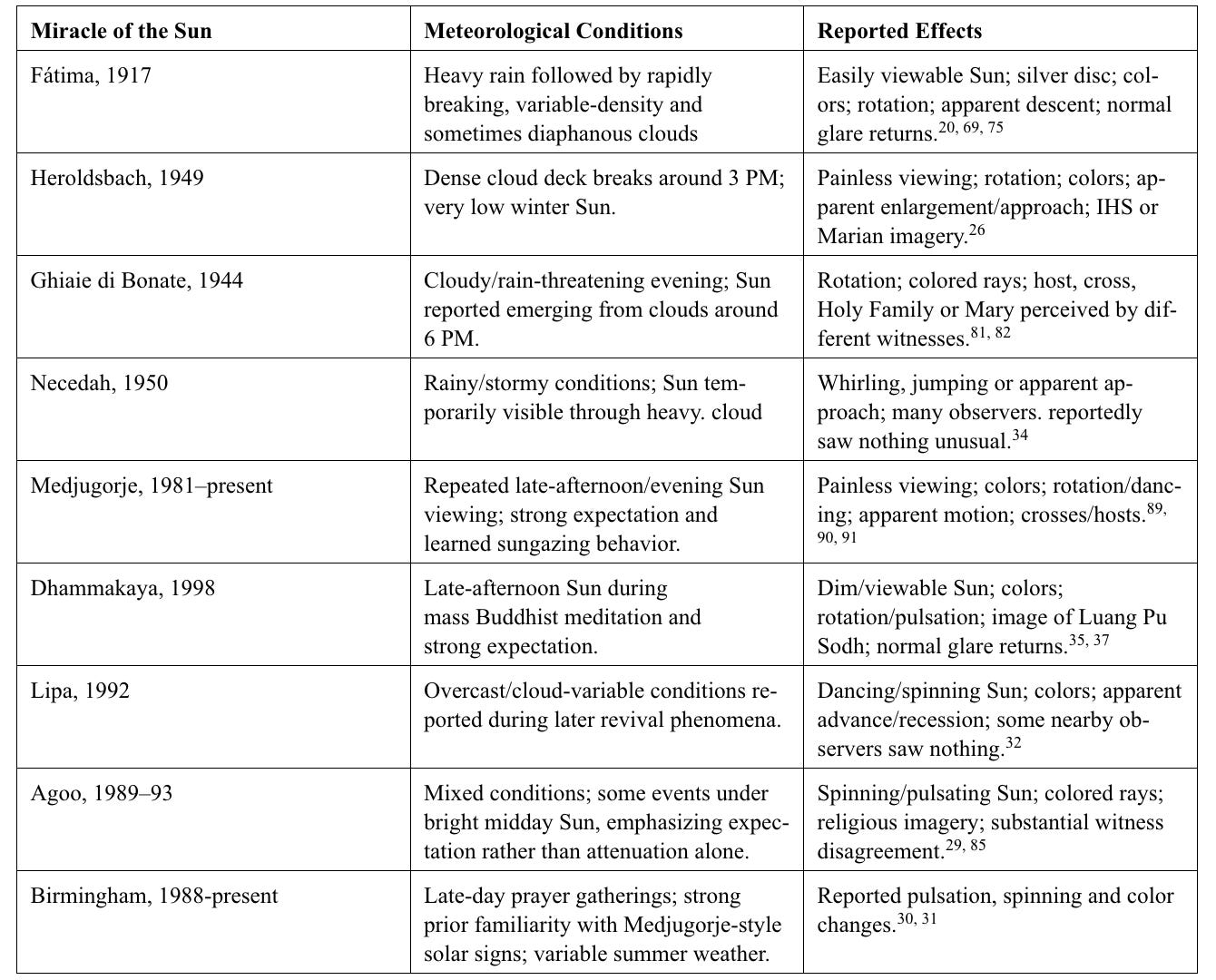
Table 1: Comparison of Reported “Solar Miracle” Cases
What is striking about these cases is not that they necessarily occurred under identical meteorological conditions, which is highly unlikely, but there was repetition in the involved circumstances that not only point to sustained solar fixation as a broadly encompassing explanation but also shed some light on the importance of priming and expectation, particularly in relation to Agoo. This is where I will present a new issue worth taking into consideration: the Problem of Counterfactuals. Essentially, imagine that the events of Fátima actually took place one month earlier, with everything else held equal. As in, say the Lady promised Lúcia that a miracle would occur on the 13th of September rather than in October. The meteorological conditions would obviously be somewhat different, maybe there would be no precipitation. But, if news really did spread of this miracle and 30,000-70,000 people showed up in September, my proposal is, and perhaps this is too radical, people would still report a Miracle of the Sun.
This is in line with the hypothesis I put forth in Section 2.2 given that religious and social priming, as situated within the larger Portuguese sociopolitical context, would be held consistent. This further weakens the conjunctive relationship between the Marian apparitions and the Miracle of the Sun itself as being mutually reinforcing. If a largely Catholic crowd expects a miracle, they will see one under a much wider array of meteorological circumstances than what one would expect. Not every feature will be consistent in this counterfactual. It’s possible the colors reported would be different. Or no one will report the Sun zigzags. But I believe that it’s not completely unintuitive to imagine something would happen that people would interpret as miraculous, independent of the exact proximate causal mechanism. Table 1 helps support this thesis given that every reported Miracle of the Sun to date, in a way, does function as a counterfactual to some degree.
Before fully delving into the Problem of Counterfactuals, let’s compare and contrast the cases to see how it can help explain (1)-(5) in particular. At Fátima, Heroldsbach, Ghiaie di Bonate, Necedah, and Lipa, witnesses describe broken, moving, overcast, or rain-associated cloud conditions that could intermittently attenuate the Sun or alter its contrast against the surrounding sky. In other cases, such as Medjugorje and Dhammakaya, the phenomena occurred in the late afternoon or evening, when the Sun was lower in the sky and therefore viewed through a longer atmospheric path. Despite these differing gateways, the reported phenomenology is remarkably repetitive: the Sun becomes unusually easy to view, changes color, spins or pulsates, appears to enlarge or move toward the observer, and is sometimes accompanied by culturally specific religious imagery. In some cases, ordinary glare subsequently returns as well. At Heroldsbach, witnesses independently claimed that they could stare at the Sun without being dazzled, some for approximately ten minutes, and one account specifically places this while the Sun was penetrating cloud formation.26
The Bavarian police report independently records dense cloud cover withdrawing shortly before the solar phenomenon as well.26 Dhammakaya produces an especially interesting analogue.35, 37 A Chulalongkorn University professor who attended the September 1998 ceremony, which is a direct analogue to Fátima in terms of being a highly educated witness, said the Sun became “like a drawing” and was easy to look at without eye protection, after which she perceived the culturally expected image of Luang Pu Sodh. Medjugorje is even more interesting because ophthalmologists documented pilgrims who deliberately stared at the Sun and perceived precisely the kinds of phenomena under discussion. One saw a deep-green Sun with a gold rim after ten minutes; another reported that the Sun “danced and changed colour” while staring at it. These people subsequently exhibited clinically demonstrable solar retinopathy, however, a crucial empirical evaluation which is missing from Fátima.74 This provides support for the fact that the retina, again, has no pain receptors and yet photic retinal injury itself is not felt while it is occurring. So there clearly is no need to hit Muse’s 10^5 threshold in order for solar fixation to occur.
Muse himself concedes this here in reference to Dhammakaya:95 “Now it also turns out there’s an El Niño happening in that basically throughout this period that’s unusually strong. And it’s caused unprecedented levels of aerosol pollution and haze in this region. And so then you have a really interesting aerosol environment and a low sun.” First, there was a 1997-98 El Niño which caused severe smoke pollution, with haze peaking in September-October 1997 and its northern extension reaching Thailand. But Dhammakaya occurred on September 6, 1998, almost a year later. A peer-reviewed study in the AGU notes:77 “during 1998-2000 no direct evidence of air mass transported from Indonesia was found, and burning was much less intense than in 1997.” The Bangkok airport record for September 6, 1998 reports precipitation in the vicinity, but does not record haze that day.78
Even if that was the case, a lower Sun taken with aerosol haze is nowhere near enough to meet his threshold unless the haze was extraordinarily optically thick. If the atmosphere has to remove roughly 99.999% of the direct solar luminance, the direct beam approximately follows the Beer-Lambert (T=e−mτ), where m is atmospheric air mass and τ is vertical optical depth. To get T=10^−5, mτ=ln(100000)≈11.5. Around Bangkok at that date, the Sun would have been approximately \~20° high around 5:00 PM → air mass ≈ 2.9, ~16° around 5:15 PM → air mass ≈ 3.6, ~13° around 5:30 PM → air mass ≈ 4.5. The required optical depth for each of these would be ~3.9, ~3.2 and ~2.5 respectively. And even in this case, I’d say these numbers are rather conservative because Muse’s starting value of 10^9 is derived from the ground-level midday Sun.
For comparison, a 1998 atmospheric study describes an urban aerosol optical depth of 1.65 at 550 nm as already toward the high end of observed clear-sky aerosol values.79 Even if you take an already very high AOD of 1, it only provides a 33-fold attenuation. Muse would require an AOD of 2.5-4, which is not physically impossible but is only really produced by dense wildfire smoke. Now, interestingly a woman did notice the weather suddenly became cooler, strong wind arose, the sky became dark/overcast and then cleared, after which she perceived the Sun as pink and comfortably viewable. The following day, at the same place and (approx.) time, she deliberately stared at the Sun again and found it ‘incredibly blinding.’ Isn’t this an interesting reversal of the Coelho Problem in Dhammakaya’s favor, where she was unable to replicate the miracle?
On (2)-(3), there is clear consistency present regarding the rotation, pulsation and zigzagging as well. According to Meessen, he synthesizes the reports as follows:72 “the solar disc rotates about its centre at high speed, stops, and then begins again in the opposite direction.” At Heroldsbach, the police report describes perceived rotation plus apparent lateral displacement, other witnesses also describe the Sun moving upward and downward while rotating. At Ghiaie, witnesses reported that the Sun emerged from clouds and whirled, while colored rays were projected in different directions. At Medjugorje we have actual patients who perceived the Sun dancing during prolonged fixation. Necedah, Lipa, Agoo and Dhammakaya add various combinations of spinning, pulsation, bouncing, advance and recession or apparent approach. If we do not interpret these all to be miraculous, then clearly there’s a naturalistic explanation lying at the base of all of this. Visual science independently establishes that stationary stimuli can appear to move.
According to Riedel’s 2005 study, autokinesis is the apparent movement of a stationary luminous target during sustained fixation, and laboratory work finds the illusion increases with fixation time.80 Moving backgrounds can also produce induced motion, in which a physically stationary target appears to move relative to the observer. Importantly, motion aftereffects are another established class of illusory movement generated following exposure to motion. Meessen also makes this observation, where he discusses classical motion after-effects following from what he calls spontaneous generation of apparent motion in the visual cortex.72 He also says that the same general concept applies to oscillations and forward or backward motion. There is also an additional mechanism for something like pulsation. Meessen says local retinal or neural fatigue makes the luminosity of the disc nonuniform and fluctuating, and he describes the bright rim as unsteady because of momentary fatigue in the retinal processing system.
As for the “large-scale translations,” here is what Meessen notes: “the disc appears to detach itself from the sky, comes rapidly closer, becomes larger and brighter, frightens the crowd, and then retreats until it regains its original appearance. Such movements can occur together with rotations and lateral oscillations.” His explanation for this is the “zoom-and-loom” effect.72 A two-dimensional retinal image does not contain its distance unambiguously. The visual system can instead interpret an increase in apparent size as an object approaching. He argues that this can yield an illusory approach followed by recession.
Meessen actually makes reference to Heroldsbach here in relation to (3). From Walz’s 70+ accounts, one witness perceived the Sun approaching and receding three times, most perceived this twice and people became so frightened by the “descending sun” that they fled and threw themselves to the ground.26 An August 2, 1981 account says the Sun appeared to descend toward roughly 150 observers and then retreat. Niko Vasil’s report is even more specific: a bright wheel seemed to separate from the Sun and head toward Earth, followed by back-and-forth movement.91 Then, consider Meessen second experiment, which becomes relevant for (4) and (5) again.72 His cross-case description says that after several minutes: vivid blue, red, yellow, green, pink, violet colors appear, they change through time, they extend beyond the solar disc, there are large irregular portions of the surrounding sky become colored and this can even create the impression that colored light is being ejected from the Sun. After looking for several minutes, Meessen himself reported seeing colors extending approximately two to three solar diameters from the Sun.
With the sky farther away becoming progressively more luminous. The changing colors are thereby attributed to differential bleaching/or regeneration of cone photopigments together with opponent color processing. He even says the sky and ground themselves were colored, and reports of “luminous fountains” and colored lights apparently being emitted from the Sun. He proposes that afterimage-related effects can spread beyond the initial sharply localized retinal image, producing an apparently luminous colored region around it. Ghiaie is one such case where the Sun emerged from clouds and emitted yellow, green, blue, red and violet light that appeared to color the clouds, fields, trees and the crowd. Don Luigi Cortesi, a witness, reports “faces, hands and trees appearing in all the colors of the rainbow.”81
Dhammakaya also provides similar evidence, with a variety of lights emitting over a wide area and the monks themselves appearing pink.35, 37 At the Heroldsbach event, Frater Julius Eichinger reported first observing the Sun and its changing colors.26 He then returned to a position where the crowd blocked his view of the Sun. About ten minutes later, despite being unable to see it, he reported striking yellow illuminated “roads” extending across the ground from the horizon toward the hill, which is similar to Garrett’s observations at Fátima.
For (6), we can draw upon the Problem of Likeness again in relation to Table 1 given that there is certainly a reported bounded temporal structure. For Fátima, there is good evidence from Alves, Garrett, Lopes, Reis, Menitra, Lourenço that the Sun returned to its normal position and could no longer be stared at, regaining its ordinary brightness.20, 69 Heroldsbach serves as a useful analogue in this case given that one witness said that when the Sun “shone normally again,” the surrounding clouds became dark again and the extraordinary signs disappeared.26 One near-contemporary report gives remarkably specific timing too: the first solar episode reportedly began shortly after 15:00 and ended at about 15:15; a second was observed from roughly 15:30 to 15:45. The writer says another woman in the rectory had independently written down the time, agreeing with his own account. He then says that around 15:45 the rotation stopped and the priests and witnesses moved on.Hans Hille reported the Sun disappearing twice behind black clouds and that on its third emergence it appeared normal. Another witness says that after the anomalous display the Sun suddenly appeared again in ordinary bright splendor.
At Medjugorje, reports indicate that the episode reportedly lasted about 15 minutes.90, 91 A white cloud then covered the relevant area and the Sun returned to its normal place, making this one of the core elements 150 observers agreed on. Then, at Dhammakaya, the anomalous colors, rotation and imagery persisted for around 20 minutes, “after which “everything returned to normal.”35, 37 There are two naturalistic explanations for this. First, the atmospheric “viewing window” closes, where a cloud veil, haze patch, mist layer, or cloud-edge configuration can move across the solar line of sight and increase the luminosity of the Sun’s rays, thereby making it more difficult to gaze upon it. Meessen himself describes the characteristic solar-miracle sequence as ending for him after roughly 10-15 minutes when the Sun becomes “normal” and again too brilliant for continued gaze.72
Second is collective disengagement. People rapidly extract the general direction a crowd is looking, and majority gaze has a stronger effect than minority gaze. Natural-crowd experiments like Sweeny (2015) indicate that visual attention propagates socially through groups (like when people “look up” at something).83 This is further amplified by memory conformity and retrospective event segmentation, where people implicitly place a “line in the sand” for events (which is supported by Kurbey and Zacks, 2009).84 If Muse rejects such explanations, he must account for the synchrony in Heroldsbach, Medjugorje and Dhammakaya as well.
Given the above, it appears that even though the meteorological gateways were, once again, quite different, there is a wonderful convergence in the specific details, which provides support for the Problem of Counterfactuals. A more moderate apologist, like Stanley Jaki, could concede that the meteorological conditions are not by themselves miraculous but what was miraculous is that the three Fátima children’s falsifiable prediction coincided with such a rare natural phenomenon. There is less causal or conditional dependence in this regard. As demonstrated, Fátima, bluntly, is not unique, however and even under a naturalistic hypothesis, neither are the meteorological conditions that can produce these effects, given that there is such a wide breadth of them. The general conditions appear to be: reduced direct solar irradiance, increased diffuse relative to direct illumination, and spatially/temporally variable atmospheric transmission.
Observer heterogeneity adds another dimension here, where almost every case, even Fátima, saw a mix of phenomenological reporting due to the existence of different sightlines, fixation durations, adaptation states, thresholds and expectation. Negative testimonies exist in several of these cases, like in Lipa, mirroring Fátima as well (see: de Mela and Manoel’s testimonies in Section 2.3). But there is another variable to consider here and that’s agent-dependent conditions. Agoo further suggests that physical attenuation need not be the only route into fixation: strong religious expectation, strong attentional and social cueing and prior familiarity with “solar miracles” may itself encourage observers to continue looking at the Sun longer than they ordinarily would. Reports in Agoo include a January 30, 1993 episode in which the faithful were said to see the Sun turn in a circle and emit colored rays.29
The broader Agoo phenomenon itself was actually intensely expectation-laden. Judiel Nieva had been reporting regular Marian apparitions for years, crowds repeatedly gathered in anticipation of signs, and on March 6, 1993 hundreds of thousands assembled under what the Associated Press described as a “blazing sun” specifically expecting an apparition85 (which, interestingly, undercuts the “prediction” angle peddled by Fátima apologists). The relevant atmospheric gateway in this case goes against the grain given that the sun was blazing and not lower in the sky or broken up by broken or moving clouds, formally rainy skies, variable cloud thickness, intermittent attenuation or changing contrasts. This means there was strong solar intensity. And yet witnesses said it moved or danced again around dawn on March 6, further corroborated by the Bulletin who reported colored lights moving from different directions toward the Sun.29 Later summaries describe similar effects to other cases as noted in Table 1.
The strangest report is that the Sun dimmed for whatever reason and some people reported being able to see the Sun without pain. Laurice Guillen, for instance, initially refused to look, but then she did anyway, interpreting her ability to do so as extraordinary.29 This is not only highly problematic for Muse’s 10^5 threshold, but it is perfectly explained by the UNH, given that the crowd were primed and motivated to witness a miracle. As a result, I believe there is credence to the Problem of Counterfactuals here since (1) general meteorological gateways for sun miracles are common enough and (2) agent-dependent gateways can clearly be potent enough to produce comparative effects. Now, before moving onto Section 3.3, I will examine (7) as it pertains to distant witnesses, leaving (8) as well as my criticisms of LSa for Section 3.3 since it ties in more directly with the photographic evidence there. Here is a collection of all the testimonies as well as any notable details:
“I was gazing at the sun. It looked so pale to me; it did not blind. It was like a ball of snow rotating upon itself. All of a sudden it seemed to be falling, zigzag, threatening the earth.” He continues: “During the minutes that the miracle lasted, everything around us reflected all the colors of the rainbow. We looked at each other and one seemed blue, another yellow, another red… After ten minutes, the sun resumed its place, pale and without splendor” and “We were startled by the cries and exclamations of the people going by the school. The teacher was the first to run outside onto the street with all the children following her. The people cried and wept on the street; they were all pointing towards the sun”— Inácio Lourenço (1931, Alburitel school group).24, 69
“Suddenly the sun broke through the clouds and appeared in a dizzying rotation, then seemed, in an impetuous descent, to tear itself loose from the sky to fall upon the earth.” It then reports Joaquim saying that after looking back up, “the sun had gone back up and was again revolving on high, emitting, without hurting the eyes, a multicolored light,” and that “That solar leap happened three times” - Joaquim Lourenço (1959, Alburitel hilltop group).24
“I was watching sheep, as was my daily task, and suddenly there, in the direction of Fatima, I saw the sun fall from the sky. I thought it was the end of the world.” Adding: “I was so distracted that I remember nothing but the falling sun” - Albano Barros (1960, Minde).24
“I could not go [to Fatima] because my husband was an unbeliever. I was looking toward the mountain at noon when suddenly I saw a great red flash in the sky. I called two men who were working for us. They, of course, saw it, too” - Guilhermina Lopes da Silva (1960, Leiria).24
“On that day of October 13, 1917, without remembering the predictions of the children, I was enchanted by a remarkable spectacle in the sky of a kind I had never seen before” - Afonso Lopes Vieira (1935, São Pedro de Moel).43, 69
“Having hurriedly followed the Poet with the other people present to the balcony, they observed from there the marvelous spectacle which they later learned had occurred in the Cova da Iria” - Helena de Aboim Lopes (1960, São Pedro de Moel).24
“Here in Torres Novas at the same time something also manifested in the sun, but from the description they give it cannot be compared” - Adelaide Grego (1917, Torres Novas).20
“The miracle of Fatima that my father saw was on 13 October. He liked to take the train to Santo Amaro de Oeiras and spend some hours painting... He went to paint the rocky shore at the beach, and suddenly had to stop—the sun was turning... He came home enchanted... and said: ‘It was beautiful! It was beautiful!” - Berta Leite (Santo Amaro de Oeiras, 1960).24
“Arriving in Fátima, I try to see people I know, to exchange impressions. They all tell me the same thing, they all saw\... But what did they see? I ask them: “We saw the sun, covered as if by a silver plate, in a constant rotation, sending out red, yellow, and purple rays, and seeming to detach itself from the sky and approach the earth. I spoke to the people, they told me the same thing, although, in other words. They told me they had seen Our Lady, St. Joseph, the Baby Jesus, and that I know\...The entire celestial court, at the same time, had seen the dancing sun. I didn’t believe in so much vision. It’s true, it’s possible they thought they saw; perhaps a suggestion. Our people, generally very ignorant, are very credulous, and it would be easy for them to convince themselves that they really saw what they wanted to see. It’s precisely thanks to this ease of conviction that demagogic doctrines have sometimes been heard and believed by them! No one in the more educated classes told me they had seen the celestial apparition, but it is certain that everyone, educated and not, expressed their faith...I did not return from Fátima with the complete conviction that Our Lady had appeared to the children, although nothing prevented me from believing it. Nothing is impossible for God” - Leonor de Avelar e Silva Constâncio (Torres Novas, 1917).20
There were some unnamed Leiria witnesses reported by Fr. José Ferreira de Lacerda as well on 5 November 1917 who were reported as having witnessed the event in Leiria.19, 20 First, it is important for us to collate and scrutinize all the contemporary reports. Praia da Granja, Leonor Constâncio and Adelaide Grego are the most useful in this regard. The earliest attested witnesses here saw rotation, rose-colored clouds, an unspecified “event,” a phenomenon not comparable to the reports from Fátima and nothing. Importantly, Constâncio was in a car accident (her car had fallen into a ditch), so I can be charitable enough to assume that she simply missed the phenomenon in light of this. But overall this is not impressive, given that there was very minimal phenomenology shared between what was reported by this subset of distant witnesses and the larger Cova corpus. If the Sun (or LSa) really “descended,” then why did not a single one of these witnesses report this?
This is a larger symptom in the Cova corpus as well, where supposedly the Sun’s descent, perhaps the most remarkable event, was omitted by over half of the surviving testimonies. This is largely a problem related to arguments from silence. Timothy McGrew’s Bayesian treatment is particularly useful here, where an omission becomes evidential when a source would have been sufficiently likely to mention E had E occurred.86 So: P(silence∣E). If that probability should be low, silence becomes evidence against E. McGrew emphasizes that this likelihood, not silence by itself, is most salient, so I’m not arguing this is decisive in any way, but the omission of E where E is the Sun’s descent, from both the Cova corpus and Tier 1 of this witness cluster lowers the likelihood of its occurrence (some interesting work on witness consistency as it pertains to central versus peripheral details can be found in Orbach et al., 2012).87 The problem is most pronounced for the Sun or the LSa’s alleged descent, of course, but it also applies in smaller degrees for all the other missing effects. This is exacerbated by Grego’s testimony, a much more damaging statement than Constâncio’s.
The next tier of witnesses are Inácio Lourenço and Afonso Lopes Vieira, who provided their accounts 14-18 years after. Prima facie, Lourenço’s account is quite striking. But this requires quite a bit of qualification. For starters, Inácio explicitly says the children were alerted by cries from outside, the teacher ran out first, the children followed, and people in the street were already pointing toward the Sun. People in Alburitel also apparently anticipated a celestial miracle and were darkening pieces of glass with candle smoke so that they could watch the Sun (or stars) without hurting their eyes. Thus, it’s evident this village was seemingly primed for a miracle of some kind. This is not to say the people here did not see anything, given that Alburitel is only ten miles away from Fátima, and the meteorological conditions would not be noticeably different, but the agent-dependent context under which they saw these events is not dissimilar from witnesses at Fátima either.
Not to mention that this account was provided more than a decade after the alleged miracle, with a now adult Lourenço reconstructing what he remembered as a child after years of exposure to the circulating Catholic narrative and post-event conditioning, subjecting him to the same distorting factors from Loftus’ study in Section 2.3.25 As for Afonso Lopes Vieira, he explicitly notes he did not remember the children’s predictions but he still encountered something “remarkable” in the sky. The problem is this is extraordinarily nonspecific, which is ironic for a poet. He provides no further information as to whether he saw any rotation, colors, plunging, three descents or environmental illumination. Moreover, it was first recorded about 18 years later, despite Vieira having contacts with both ecclesiastical figures interested in Fátima and Formigão. I agree with Scott Alexander that it’s bizarre he did not come forward with his observations earlier.36 So on one hand, Inácio does provide high phenomenological correspondence with the events at Fátima, but it comes at the cost of high contamination as well, while Vieira is likely more independent, but vague.
Then, the third tier of witnesses are Joaquim Lourenço, Albano Barros, Guilhermina da Silva, Helena Lopes, and José and Berta Leite, who all provided testimony four decades after. Joaquim is possibly the most impressive of the bunch, providing evidence for a separate Alburitel group. It is also important to note Joaquim is Inácio’s older brother, hence the same last name. This account was related about 42 years after 1917, however, through an interviewer rather than surviving as a contemporary deposition. The same distorting factors discussed for the Tier 2 witnesses are even more so present here. The later the testimony, the harder it becomes to treat detailed convergence as statistically independent. Then, there’s Albano Barros, who I personally find the most interesting. The primary reason is because, like Vieira, Barros was not seeking out a miracle per se.
He was watching his sheep when he suddenly saw the Sun fall from the sky and noted it was “in the direction of Fatima.” Muse further emphasizes the fact that he reported everyone in his area thought the world was ending. Again, however, this is a childhood memory recalled more than forty years later, with the latter claim coming from John Haffert’s own synthesis of the testimony24, where he writes: “[B]arros was overcome by the common fear: Almost everyone in the area thought it was the end of the world.” Muse thereby misrepresents his testimony. Additionally, “in the direction of Fátima” could easily be a retrospective localization rather than an actual azimuth observation, which makes a lot more sense than what Muse really believes. Muse’s hypothesis, it turns out, is just rendered all the more strange since, according to his own reconstruction, the real astronomical Sun was not in the direction of Fátima at that time. And this is taken as evidence that Barros saw Dalleur’s hypothetical localized source, or LSa, rather than the astronomical Sun.
That means the Sun was also present in the sky, just in the opposite direction, and, for some reason, Barros identified LSa with the actual Sun. Presumably, Barros does not suffer from selective vision, so when he saw the LSa “fall from the sky,” did he not simultaneously, or even immediately after, notice the actual Sun in the opposite direction? Thus, would it not be noteworthy for him to mention that what he really witnessed was two self-luminious objects rather than one? Dalleur could argue the real Sun was obscured by a cloud somewhere, but that’s yet another assumption. It’s a lot more straightforward to chalk up Barros’s reference to the direction of the Sun to retrospective memory contamination than the LSa, which also tracks with the fact that Barros told Haffert he remembered nothing but the Sun falling. The other testimonies from Tier 3 are, frankly, less interesting. Guilhermina Lopes da Silva’s account is modest. She notes that there was a red flash in the sky, but she also notes that she knew about Fátima and says she wanted to attend but could not because her husband was an unbeliever.
Helena de Aboim Lopes, Alfonso’s wife, notes a “marvelous spectacle,” which is just as vague as Alfonso’s. It’s also correlated with her husband’s testimony given that her deposition came so much later than his. José Leite was the actual observer, but his daughter Berta Leite notes while painting at the rocky shore, he stopped because “the sun was turning,” later returning home delighted and saying, “It was beautiful!” Muse places Santo Amaro de Oeiras around 120 km from Fátima, which sounds impressive, but this is evidentially among the weakest named reports. It’s a secondhand testimony, where the sole specific feature is simply a reported rotation. Muse claims that “nobody from that far away would have been expecting to see a miracle,” but there is no independent reason to believe this, especially when Berta herself was later deeply involved in Fátima devotional culture: by 1946 she was publishing in the shrine newspaper Voz da Fátima, including an article titled “Embaixador de N. S. da Fátima.”88 The upcoming miracle was also well-known in Portugal.
Additionally, this testimony poses another problem for Muse. From Santo Amaro, Fátima lies roughly 28° east of north-northeast. Around solar noon, however, the astronomical Sun was roughly to the south. Thus a hypothetical luminous source (LSa) located near Fátima and the real Sun would have been in radically different sectors of the sky. Moreover, at \~117 km distance, the LSa only 1.5-3 km above the terrain would appear very close to the horizon, not where an observer normally expects a midday Sun. Accounting approximately for Earth’s curvature, such a source would be only on the order of fractions of a degree to about a degree above the horizon. So, what exactly does Leite’s testimony corroborate? If José meant the actual astronomical Sun, then it’s a remote report of an apparent solar rotation. If he meant LSa, then José was supposedly looking toward a near-horizon luminous body in the northeast without mentioning the new, extraordinary location of the Sun.
Another peculiar problem I would like to note is that there’s a considerably large population in the 120 km vicinity around Fátima. If either the LSa, or the actual Sun, was behaving this dramatically, why would we not expect significantly more witness testimony and press coverage in these regions? Barros apparently thought the world was ending, why did no one else? Finally, there’s a Problem of Likeness present for (7) as well. At Ghiaie di Bonate, in the town of Tavernola Bergamasca, there was a parish bulletin describes the event:82 “At 6:00 PM sharp, a dimming of the sunlight was felt, accompanied by a sudden flash of lightning… [l]ooking at the sun, one saw first green, then bright red, then golden yellow, and then it spun around dizzily… [a]fter ten minutes, the sun returned to normal.” The parish priest then personally confirmed “I was among those deluded that evening,” “from a slightly hidden window, I watched the sun change color and spin rapidly,” and “many of us here in Tavernola have been deluded.” Italian source reports also placed witnesses in Brescia and Piacenza, although there are no direct witness testimonies that I could find.
Meessen also notes,72 “[i]n Fatima and Heroldsbach, there are some reports concerning apparently simultaneous observations of the same phenomena about 5 km and even more than 40 km away.” The Heroldsbach priest Johannes Gailer is quoted as claiming the phenomenon “was seen within a radius of 45 kilometre.” And Walz writes that in Pinzberg, which he describes as roughly 15-20 km east of Heroldsbach, the Heroldsbach solar phenomenon was reportedly also seen, according to Pastor Bierfelder.26 For Medjugorje, Dwight Longenecker reports observing from his guesthouse balcony:89 “At 6:20 Eleanor gave me an elbow in the ribs and pointed. The sun was now a disc of white light in the sky like a Eucharistic host… it began to spin, first clockwise then anti clockwise. Sparks spit out from the rim of the sun like a firework… when we spoke about it to our fellow pilgrims they said many people in the town square had reported the same phenomenon.”
This is an example of a separated local group rather than truly distant but still worth noting. A 1981 Catholic report says reporters interviewed witnesses from Medjugorje, Ljubuški, Mostar, Posušje and considerably farther away as well, all of whom had allegedly witnessed the phenomenon.90 Therefore, if Muse would like to posit distant witness testimony as evidence for the veracity of Fátima, he faces the symmetrical problem with Ghiaie di Bonate, Heroldsbach and Medcjugorje. Under a naturalistic model, the common cause for all of this phenomenon is simply the Sun. Someone 40 km from Heroldsbach can stare at exactly the same astronomical object as someone at Heroldsbach and thus produce similar reports. Modern atmospheric work, in fact, like Mol’s study “Mechanisms of surface solar irradiance variability under broken clouds,” shows that broken cloud fields produce large and rapid changes between attenuated direct sunlight and much brighter conditions, on spatial scales extending over kilometres and temporal scales of minutes, which explains why places like Alburitel and Minde would converge so much more with the Cova.92
3.3. The Physical Evidence
If you found the previous sections to be too technical, you can at least take solace in the fact that this one will only be increasingly so. But I will try to be as succinct as possible. The physical evidence for the Miracle of Fátima is primarily photogrammetric.68 The central photograph is D115, a photograph of the crowd during the event. Dalleur infers the direction of the illuminating source by tracing shadows in the image and Muse presents this as potentially objective evidence that the light people were looking at was not the astronomical Sun. Instead it was a second self-luminous object (LSa). The basic claim is as follows: (1) the real astronomical Sun should have been at roughly 42° elevation, (2) there appears to be diffuse illumination consistent with that Sun being behind cloud, (3) but several sharper shadows allegedly converge on a second direction corresponding to a more localized point source at roughly 30° elevation. Dalleur’s reconstruction thereby involves a diffuse source around 42° and a point-like source around 30°.
The 42° source matches the expected astronomical Sun while the lower source is interpreted as the object witnesses mistook for the Sun. The reason Dalleur and Muse believe this is difficult for the naturalist to explain is because the physical shadows really show a bright point-like source at an elevation significantly different from the astronomical Sun, then the photograph would apparently be showing an external physical anomaly. If this object does exist, nearly every argument I’ve provided thus far would fall kaput. Therefore, the naturalist would have to explain why physical shadows appear to point toward a non-solar light source. Included below is every photo, directly sourced from the Arquivo do Santuário de Fátima:93
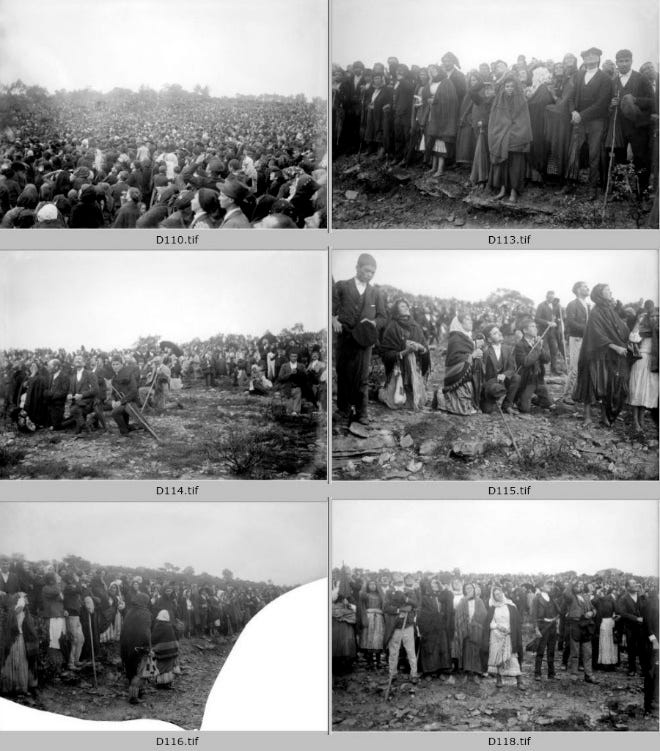
Figure 2 (gallery)
The hardest facts to explain away are (1) the fact that multiple independent shadows allegedly converge and that (2) the “clouds fooled the shadow calculation” response allegedly creates blurry shadows. The evidence for LSa is the first horn. The second horn is that the photograph visibly shows apparently dry clothing, which corroborates witness testimony claiming that people were thoroughly soaked immediately before the event and then became dry during or immediately after it. One example of this is Louis Lopes, who reportedly said he was soaked from his feet to his waist but became completely dry as the Sun appeared to descend. This argument focuses on a particular boy (marked in red in Figure 1). Dalleur identifies three tonal regions on one boy’s trousers: (1) a dark horizontal band near the hips, (2) a darker vertical region along the fly, and (3) another irregular darker patch on one side.
Dalleur interprets these as residual wet regions,68 The theory is that intense infrared radiation suddenly dried the fabric that was directly exposed, while fabric shielded by the jacket, folds, seams, the fly, etc., remained wet. The most difficult facts to explain in this case is that (1) the dark boundaries allegedly follow clothing geometry, (2) the dark fabric allegedly looks like wet cloth and (3) another photograph, D114, allegedly shows re-wetting. There are others, of course, but this should be the gist of it. I would like to first note that Mark Grant, a PhD mathematics student, went into considerable detail already as to why Dalleur’s arguments are lackluster, for both horns of the debate. It’s a very sophisticated and well-crafted takedown, one I encourage any readers to refer to if this is of interest. Grant actually constructed simulations where bright cloud illumination caused Dalleur’s method to misestimate solar elevation by something like 15–20°. Muse responded to Grant in his post dedicated to Scott Alexander. Since Grant has already gone into much more detail on this matter, I will not spend too much time rehashing the argument since its beyond the scope of my analysis here. Additionally, as of 9/8, Grant has mentioned to me that he is, in fact, working on additional lines of argumentation on this matter after Dalleur and Muse’s responses to him, so I don’t want to misrepresent his views on the topic.
Therefore, I would like to evaluate the testimonial evidence Muse relies on to independently argue for LSa. First, Muse cites a Raio de Luz publication, where the author described a “luminous disc” that appeared as though it had “detached itself from the sun” or had been placed in front of it.20,95 Second, is Maria Campos, who described a rounded, silvery, moon-like object that “emerged from the sun,” moved toward the observers, returned to the Sun, and ultimately disappeared among the clouds. Muse also cites a second tier of testimony that is consistent with the LSa, but not necessarily one that independently establishes the existence of this self-luminious object. José Garrett says the disk could not be confused with a Sun seen through fog and describes clouds passing across it without eliminating its sharply bounded appearance, Mario Godinho reports seeing the object in a clear patch of sky, Avelino de Almeida describes the Sun as a dull silver plate visible without eye pain; José Curado says that with the Sun cloudless, a pale silver plate appeared. I’d like to note the second-tier witnesses actually identify the object as the Sun here.
It is rather bizarre that there really was another self-luminous object that the vast majority of testimonies decided to leave out, especially since he places it at an altitude somewhere around 1.5-3 km above sea level, and, from Torres Novas, this hypothetical object would have appeared only about 4.5-8° above the horizon. At the moment represented by D115, LSa cannot simply be covering the real Sun on Dalleur’s own photogrammetric reconstruction, which poses yet another bizarre strain of the same problem. Assume that, pro Luz, Muse could argue that LSa was simply covering the Sun which is why people mistook it for the actual Sun, then why exactly did people not say anything regarding the LSa allegedly had a different angular elevation, roughly 25–32°, while the actual astronomical Sun would have been at around 42°?
There would be a ~12° difference in vertical separation and taking the Sun’s diameter as 0.5°, this means there’s 24 solar diameters (since 12°/0.5° = 24). If both sources were simultaneously visible at those positions, they would appear dramatically separated in the sky. So, once the LSa descended, I would have expected more people to report that the astronomical Sun has been left behind. Surely this is a rather remarkable and noteworthy sight, no? Unless, again, God hid the true Sun with a cloud after the LSa descended, which is characteristically ad hoc. In general, it feels strange to reject the vast majority of testimony that identifies all the alleged phenomena (rotations, translational motion, etc.) with the Sun itself as this was one of the largest points of convergence in the primary literature, all because of two idiosyncratic pieces of testimony.
However, this aside, it’s critical to note that Luz’s language is quite uncertain. He first says the luminous disc appeared “detached,” then qualifies it by saying it placed itself before the Sun. To me, this suggests that the bright object “placed before” the Sun could be transmitted or scattered solar light rather than its own emitter. If there really were one external LSa, independently visible to everybody, we’d expect convergence on its basic object-properties. But, given how asymmetrical these reports are, especially the second-tier testimony, multiple sources are more plausible than a single LSa. In fact, Meessen independently makes the same point, noting that the initial gray disc can suggest something like a UFO or screening object, but when he works through the geometry, he rejects this.72
A physical object between observers and the Sun should generate a cone of shadow, including regions of partial or annular eclipse. Such reports are absent, however. And geographically distant reports make a single screening object even less plausible because it would need enormous dimensions or coordinated multiple objects. In his first experiment, if you recall, Meessen says he personally reproduced this initial stage while looking at an ordinary low Sun. He reports that the Sun was immediately transformed into a nearly uniform grey disc surrounded by a brilliant ring coinciding with the solar rim. He interpreted this as adaptation to intense illumination, not an external object.72 Thus, Raio is most likely describing the same central disc, where the “detaching” phenomenon is more so attributed to the zoom-and-loom effect. Campinos’ account is even more discordant.
Per Meessen, the silver veil could be the same disc the author from Raio de Luz described and whatever object “emerged” from the Sun were colored spheres due to retinal adaptation. The white “snow-like” thing could therefore involve a real bright or whitish cloud fragment, cloud opening, or changing patch of transmitted/scattered sunlight near the Sun. The evidence we have on hand is simply too ambiguous. Another objection Muse has not bothered addressing is the discordance between the ending of the event and what the ending would be interpreted as being with two self-luminous objects. What exactly happened to LSa after its appearance? Did it return to the Sun and then vanish? That seems highly dubious.
Next, let’s examine the second horn. Could there be a naturalistic explanation for the rapid drying of clothes? According to Muse, ordinary post-rain drying is implausible given that (1) the crowd was very wet as indicated by witness reports, weather records and photographs showing heavy rain and overcast conditions before the event, (2) the ambient environment was terrible for evaporation given that the midday temperature around 15-20°C and assumes high relative humidity immediately following prolonged rain, and (3) witnesses supposedly go from “sopping wet” to “completely dry” over approximately the duration of the solar event, roughly ten minutes in many accounts. Muse is unconvinced by psychological objections where witnesses might have merely misjudged either how wet they were or how quickly clothes normally dry, thinking that the combination of prior rain as well as the reported complete dryness is too extreme to dismiss as ordinary subjective miscalibration.
First, the testimonies themselves are highly dubious. One of the earliest relevant witnesses, Carlos Silva, described having been soaking wet and later finding himself dry, but his own estimate of the relevant interval was around twenty minutes, and he explicitly asked whether this was miraculous and answered, “I do not think so.” This statement was taken in 1917, only days after the event. Stanley Jaki, despite defending Fátima, likewise concludes that the records warrant only saying that some people reported sudden drying while others did not even notice it.69 Olivia Mendes’s 1922 account is even more troublesome. She says that because it did not rain again and the Sun returned, they eventually reached Leiria dry, which Jaki interprets her account as gradual ordinary drying.69
Dominic Reis creates an additional problem, one from chronology. His late account (1960) says that after the Sun had returned to its normal position, a strong wind began blowing and “in a few minutes” the ground and clothes became dry. If that testimony is taken as corroboration of rapid drying, it provides an alternative mechanism for why the drying occurred, one that contradicts Muse’s preferred infrared radiation explanation. It also places the drying after the purported LSa display rather than during an infrared irradiation phase. The best early positive testimony in favor of Muse’s claim comes from Inácio António Marques, in 1922: “The sun gyrated on itself and all who were drenched appeared dry as I was.”19,20
“All” is a generalization from those in Marques’ vicinity, which lends some plausibility to the fact that people were at least relatively drier than before. It is important to note, however, that this testimony does come five years later. Consider what Marques said just before: “The moment of the apparition arrives and what everyone knows takes place.” Fátima already had a developed public narrative by this point, which points to some possible contamination. And, more crucially, the Portuguese e (“and”) merely coordinates the two propositions “the sun gyrated on itself” and “all who were drenched appeared dry as I was” and is not substitutable with “while” or “during,” indicating that the drying did not necessarily take place when the Sun was gyrating. A more natural construction would have something like “enquanto o sol girava” if this was the case.
Further, note the tense shift: “girou” is preterite whereas “aparecem enxutos” is in the present tense. This is rather awkward if Marques meant to invoke parallelism between the events. The more natural reading is that “the sun gyrated on itself” is a specification of “what everyone [already] knows [took] place.” The drying observation then follows as an additional coordinated fact, meaning that we still have no reference to the temporal duration between T1, when everyone was soaking wet, and T2 when everyone appeared to be dry. The more extravagant claims with respect to drying can be found in the 1948 Rambaud interviews and Haffer’s 1960 corpus.24,96 Manuel Pedro Marto talks about how a puddle had disappeared and the ground was dry, but he does not mention anything regarding their garments, which is a bit of a strange omission.
Sister Maria de Jesus Antunes Carreira provides the most dramatic retelling, saying she was “soaked to the bones” and then all her clothes dried instantly, even her undergarments. She would have been 10 years old during the event. José Maria Pereira Gens said his clothes were somewhat soaked, but he felt they were almost completely dry later. Jaki immediately comments that this fifty-year-late account showed “traces of subsequent reflections and of extraneous information.”69
From Haffer’s corpus, Guilhermina Lopes da Silva reports what her relative, Louis Lopes, told the family:24 “although he had taken every precaution to avoid the rain… he was soaked through from his feet to his waist. But as the sun came down from the sky he noticed, to his astonishment, that he was completely dry.” This is another secondhand testimony, one recorded more than forty years later. Others from this corpus include Maria Teresa of Chainça, José Joaquim da Assunção, Higino Faria, an unnamed woman living near Albany, New York, Mário Godinho, Augusto Pereira dos Reis, João Carreira, Maria do Carmo Marques da Cruz Menezes, Joaquim da Silva Jorge, Maria Cândida da Silva, Manuel António Rainho, Maria José Monteiro, Júlio Vicente and Joaquim Vicente. All of them say something in the ballpark of “my clothes were wet and then they were suddenly dry.” The problem, beyond the obvious issues incurred by late testimony, is Haffer’s methodology.
He asks what are known as leading questions, which infamously distort direct witness testimony and are restricted in legal contexts for this reason. For Maria Teresa, Haffert asks whether her clothes were “wet before, then suddenly dry,” and she simply answers “Yes.” Haffert sometimes paraphrases rather than preserving the witness’s exact language. Haffert also sometimes paraphrases rather than preserving the witness’s exact language. An anonymous woman’s testimony, for example, is summarized by Haffert as affirming that everyone had been wet and “suddenly” dry rather than reproduced as a direct quotation. The wording is also inconsistent. Some witnesses say “suddenly,” some merely say “afterward,” some say they “did not notice” the transition, and some give no timescale at all. So I am not saying there is no merit to these accounts but they should be approached very cautiously. I am also not saying that it’s not possible some form of expedited drying occurred on October 13. In fact, I do find Reis’ testimony to be rather interesting.
Wind removes the locally humid air sitting directly against the garment and continually replaces it with new air. Laboratory textile research actually treats air velocity as an important parameter governing evaporation from wet fabrics (see Liu’s 2020 study, “Prediction of the water evaporation rate of wet textile materials in a pre-defined environment” for more on this.)97 Wind, in conjunction with the fabric itself becoming warmer than ambient when irradiated, both from the Sun as well as from body heat, could serve as a plausible explanation in this regard.
To do some quick napkin math, take T_air = 17°C and RH = 90%, and test wind speeds of 1, 3, and 5 m/s. Rather than simply assuming that the wet clothing remains at some temperature above ambient, however, the more physically complete approach is to treat the wet-cloth surface temperature, T_s, as the product of a surface heat balance. In quasi-steady form, this can be written approximately as q”_solar + q”’_body = q”_conv + q”_LW + q”_evap, where absorbed shortwave solar radiation and heat conducted outward from the body supply energy, while convection, longwave radiation, and evaporation remove it. More explicitly, q”_conv = h_c(T_s-T_air), q’‘_LW = εσ(T_s^4 - T_surr^4), and q”_evap = h_e[p_sat(T_s) - p_a]. If the changing temperature of the wet fabric over the ten-minute period is important, a storage term, C_A(dT_s/dt), can simply be retained on the left-hand side rather than imposing a steady state. A standard forced-convection approximation measured on the human body is roughly h_c ≈ 10.3v^0.6, with h_c in W/m²K and v in m/s. The Lewis relation then gives an evaporative heat-transfer coefficient of roughly h_e ≈ 16.5h_c.
That same Lewis-relation framework, as used in Liu’s 2020 study, indicated that experimental textile evaporation rates were generally between about 50% and 100% of the calculated maximum, with evaporative cooling reducing the rate, particularly at higher wind speeds. At 17°C, saturated water-vapor pressure is about p_sat(17) ≈ 1.94 kPa, so at 90% RH the actual ambient vapor pressure is p_a = 0.90(1.94) ≈ 1.75 kPa. The relevant vapor-pressure gradient is therefore Δp = p_sat(T_s) - p_a. For reference, if the heat balance permits the wet surface to reach only 20°C, p_sat(20) ≈ 2.34 kPa and Δp ≈ 0.59 kPa; if it permits the surface to reach 25°C, p_sat(25) ≈ 3.17 kPa and Δp ≈ 1.42 kPa. These values can therefore be treated as useful sensitivity cases rather than temperatures simply assumed to persist independently of the available heat.
The important point is that even 90% relative humidity does not eliminate evaporation once the wet surface is warmer than the surrounding air. For any surface temperature supported by the heat balance, the mass-transfer-limited evaporative heat flux is approximately E_max = h_eΔp, and the corresponding water loss over ten minutes is m = E_max(600)/L_v, where L_v ≈ 2.45 x 10^6 J/kg. The heat balance thus constrains whether a given T_s, and consequently a given evaporation rate, can actually be sustained. Consider the following sensitivity table based on these assumptions:

Table 2: Estimated Ten-Minute Evaporation Capacities
(^special thanks to Jerry Springer, a PhD ChemE student who assisted me with the above derivations)
Given the above, moderate warming combined with wind can remove tens of grams of water per square meter within minutes even in very humid post-rain air. These calculations are independent of dripping and gravity drainage, as well as capillary redistribution between garments, which may also increase the rate at which clothing can dry. The point is that assuming natural conditions, especially wind, surface water could be removed to make the garment feel dry. In other words, this is a phenomenological threshold, I’m not arguing that it’s plausible for a person to be fully bone-dry within ten minutes. The relevant threshold is whether the person simply feels dry. The first round of water removed may matter more phenomenologically in this regard since it’s typically disproportionately responsible for things like visible surface film, dripping, evaporative cooling and fabric cling. Also, to strengthen the psychological objection, humans do not possess dedicated skin humidity receptors. Instead, wetness is inferred from coolness and tactile signals. In experiments (like Filingeri 2015), applying a warm wet stimulus has actually suppressed the perception of wetness so strongly that subjects sometimes fail to recognize that the stimulus is wet.99
Therefore, my proposed explanation is that wind, in addition to body heat, accounted for a sufficient amount of water evaporation, enough for people to believe they were drier than they were. Additionally, this drying sensation occurred over a longer timeframe than what later accounts may imply, closer to Carlos Silva and Olivia Mendes’s horizons (note: double the water loss for the 20 min estimation). Later accounts are likely a result of contamination since most of the earliest newspaper summaries failed to mention this “rapid” drying phenomenon, again invoking Timothy McGrew’s Bayesian treatment.86 The naturalistic model incorporates the inconsistencies a lot better than infrared-enabled drying, given that the reports disagree not merely over the degree of dryness but over when the drying occurred, how quickly it occurred, whether it was noticed at all and what physical conditions accompanied it. A single powerful infrared source need not dry every garment uniformly, given folds and occlusion, but it should nevertheless generate some systematic relationship between exposure to the source and the timing and degree of drying. Heterogeneous outcomes across different observers are much more expected under naturalism. Not to mention there were also rapid drying reports at Heroldsbach as well, where multiple witnesses later reported soaked clothes becoming dry, posing yet another Problem of Likeness for Muse and Dalleur.26
I would also like to note that my hypothesis as it pertains to “natural” rapid drying could also be (defeasibly) applicable to the discussion on whether there’s evidence for such a phenomenon in the photographs themselves. From my perspective photographic dryness mostly provides surface evidence (as in what the camera records is an optical consequence of water in the visible region of the textile) and cannot account for whether water remains deeper in the fabric, in between layers or in the garments facing the body. For instance, Bell and Grosberg’s 1962 study of thick textile materials found that during the falling-rate stage of drying, the textile could have dry outer layers while a central core still contained liquid water. Second, I mentioned dripping, gravity drainage, etc., as other water-loss mechanisms, which could remove the most visually conspicuous water.
Again, I ask any readers to read Grant’s paper for more information on this. Also, its possible he will have new objections relatively soon that I’ll be sure to redirect to. I would really like to stress that this section is perhaps the most subject to change given that multiple independent parties are scrutinizing and verifying Dalleur’s findings, which should reveal more information in due time.
Conclusion
So, were the events on October 13th, 1917 miraculous? I would say, yes, if we take miraculous to mean very effective or surprising. But surprising is not remotely tantamount to “supernatural.” While I have my reservations with Hume, I do partake in his brand of skepticism, not just because miracles may violate the natural order of the world, but because there are upwards of thousands, perhaps even millions, of miracle claims dispersing our contemporary and historical records. And from what I’ve observed, they all share too many properties in common for any one of them to stray from the herd. There has not been one miracle that I can confidently say belongs in a different classification whatsoever without having to also apotheosize every other claim, in virtue of their inherent status as companions in guilt. In the case of Fátima, I will admit that I was initially disquieted by the bare facts of the story. You have three uneducated shepherd children who experience Marian apparitions on a consistent basis until, one day, the Lady informs them that there will be a miracle on October 13th. One that would make “everybody believe.”
And lo and behold, on that very same day, with 70,000 people densely packed into the Cova de Iria quarter, people did see a miracle. They saw the Sun dance. Truly, what are the chances of that? Over the course of the coming decades, dozens, then hundreds, of people clamored to tell their side of the story, contributing to an impressive amount of convergence in the details. All in all, this is extraordinary and surely unprecedented under naturalism, right? But I believe the drift between “extraordinary” and “ordinary” is not as immense as one might expect. In fact, it’s just a matter of perspective. Imagine you’re trekking along the Sahara desert and you suddenly notice a shimmering pool of water slicking the distant playa, one reflecting the sky so deeply that you convince yourself it really is there. Thirsty and exhausted, you pick up the pace and try to make your way to the pool, but as soon as you take just one more step closer, it vanishes. It was a mirage this entire time, a common occurrence in flat deserts and even open highways. This was my experience as I researched the Miracle of Fátima. Because the more testimonies I unearthed, and the more comparative cases I found, the less wonderstruck I became. And, soon enough, Fátima was no longer extraordinary.
The children themselves fit into a tried and tested template. They were young, devout, embedded within a Marian culture, and critically, were not the first children to report experiences of this kind. Marpingen, Heroldsbach and Ezkioga demonstrate that clusters of young seers can sincerely report elaborate, interactive and mutually reinforcing Marian experiences without the Church itself concluding that the Virgin Mary appeared. Fátima may differ from each of these cases in degree, but I have been unable to identify a categorical symmetry breaker. The Miracle of the Sun undergoes an even more dramatic demystification. A silvery Sun that can be stared at, rotations, pulsations, changing colors, apparent descents, colored landscapes and an eventual return to normal brilliance initially sound like an astonishingly specific conjunction. But these properties recur at Heroldsbach, Ghiaie di Bonate, Necedah, Medjugorje, Lipa, Agoo and Dhammakaya. They recur in Catholic cases the Church has rejected, in cases on which it has suspended judgment, and, most damagingly, in a Buddhist context.
The atmospheric gateways vary, but the perceptual output remains remarkably consistent. Domingos Pinto Coelho’s reproduction of rotations and colors on the following day is especially salient because it demonstrates that at least some of the supposedly extraordinary phenomenology was repeatable without another Marian apparition. When taking the entire reference class into consideration, and making note of all the shared features between such comparative cases, all the similarities start to stack up in a way that points more so toward a naturalistic explanation for this phenomenon. What were once thought of independent streams of evidence and testimony are actually now co-reporting, which undercuts the utility of a multiplicative model, thus motivating the naturalist to adopt a single unifying (yet non-reductive qua William Christian, Jr.) explanation that accommodates for not just the convergence in the data but the divergences.
When taken holistically, the UNH appears to be more attractive than the SCH, which is more ad hoc than it may appear, especially with the introduction of LSa. On this basis, I believe the closer one gets to Fátima, the less it resembles an oasis and the more it resembles exactly what it’s always been: an impressive mirage.
References
James, William. Pragmatism: A New Name for Some Old Ways of Thinking. Longmans, Green, and Co., 1907.
Muse, Ethan. “Our Lady of Fatima: Inaugurated by Miracles — Part 1.” Motiva Credibilitatis, 5 Sept. 2025.
Adelstein, Matthew. “Are the Fatima Children Unprecedented?” Bentham’s Newsletter, 15 Apr. 2026.
Adelstein, Matthew. “A Clash of Titans: The Ethan Muse Dustin Crummett Fatima Debate.” Bentham’s Newsletter, 4 Mar. 2026.
Muse, Ethan. Substack Note discussing prediction, accommodation, and total evidence. Motiva Credibilitatis, 5 Mar. 2026.
Ahmed, Arif. “Hume and the Independent Witnesses.” Mind, vol. 124, no. 496, 2015, pp. 1013–1044. doi:10.1093/mind/fzv076.
Kruskal, William H. “Miracles and Statistics: The Casual Assumption of Independence.” Journal of the American Statistical Association, vol. 83, no. 404, 1988, pp. 929–940. doi:10.1080/01621459.1988.10478682.
Hume, David. An Enquiry Concerning Human Understanding. 1748. Section X, “Of Miracles.”
Babbage, Charles. The Ninth Bridgewater Treatise: A Fragment. 2nd ed., John Murray, 1838.
Maunder, Christopher John. Apparitions of the Virgin Mary in Modern European Roman Catholicism (from 1830). PhD dissertation, University of Leeds, 1991.
Medjugorje.com. “Bishop Žanić Did the Will of God.” Reproduced interview/material concerning Bishop Pavao Žanić.
Bello Ricardo, Pío. Pastoral Instruction on the Apparitions of the Blessed Virgin in Finca Betania. Diocese of Los Teques, 21 Nov. 1987.
Dicastery for the Doctrine of the Faith. Norms for Proceeding in the Discernment of Alleged Supernatural Phenomena. 17 May 2024.
Beitia Aldazabal, Eugenio. “Official Note on the Events of San Sebastián de Garabandal.” 7 Oct. 1962. Boletín Oficial del Obispado de Santander, Nov. 1962, p. 242.
Morales, Luis. Public lecture concerning the Garabandal events. Ateneo de Santander, 30 May 1983.
Carnap, Rudolf. Logical Foundations of Probability. University of Chicago Press, 1950. §45B, “Requirement of Total Evidence.”
Eddington, Arthur S. The Philosophy of Physical Science. Cambridge University Press, 1939.
Santuário de Fátima. “Chronology.” Santuário de Fátima. Official chronology of the Fátima events.
Santuário de Fátima. Documentação Crítica de Fátima. Vol. I: Interrogatórios aos Videntes (1917). Santuário de Fátima, 1992.
Santuário de Fátima. Documentação Crítica de Fátima. Vol. III-1: Das Aparições ao Processo Canónico Diocesano I (1917–1918). Santuário de Fátima.
Jenniskens, Peter, et al. “Tunguska Eyewitness Accounts, Injuries, and Casualties.” Icarus, vol. 327, 2019, pp. 4–18. doi:10.1016/j.icarus.2019.01.001.
Rudwick, Elliott M., editor. East St. Louis Race Riot of 1917. University Publications of America, 1985. 8 microfilm reels.
Correia da Silva, José Alves. “Carta Pastoral sobre o Culto de Nossa Senhora de Fátima.” Diocese of Leiria, 13 Oct. 1930.
Haffert, John M. Meet the Witnesses. International Press, 1961.
Loftus, Elizabeth F., David G. Miller, and Helen J. Burns. “Semantic Integration of Verbal Information into a Visual Memory.” Journal of Experimental Psychology: Human Learning and Memory, vol. 4, no. 1, 1978, pp. 19–31. doi:10.1037/0278-7393.4.1.19.
Walz, Johann Baptist. Die Muttergotteserscheinungen von Heroldsbach-Thurn: Die Protokolle von Augenzeugen … von Anfang an bis zum 2. Römischen Dekret (9. Oktober 1949 bis 25. Juli 1951). 3 vols., Frensdorf bei Bamberg, 1958.
Dicastery for the Doctrine of the Faith. “‘The Queen of Peace’: Note About the Spiritual Experience Connected with Medjugorje.” 19 Sept. 2024.
Diocese of San Fernando de La Union. Theological commission judgment concerning the alleged Agoo apparitions. 1993.
de la Cruz, Deirdre. Mother Figured: Marian Apparitions and the Making of a Filipino Universal. University of Chicago Press, 2015.
Caritas of Birmingham. Account and eyewitness reports concerning the alleged “Miracle of the Sun” of 2 July 2023. Caritas of Birmingham.
Caritas of Birmingham. “Disclaimer.” Statement concerning its relationship to the Diocese of Birmingham.
Supreme Sacred Congregation of the Holy Office. Decree concerning the alleged apparitions at Lipa, Batangas. 28 May 1951.
Bernareggi, Adriano. Episcopal decree concerning the alleged apparitions at Ghiaie di Bonate. Diocese of Bergamo, 30 Apr. 1948.
Treacy, John P. Decree concerning the alleged revelations of Mary Ann Van Hoof at Necedah, Wisconsin. Diocese of La Crosse, June 1955.
Scott, Rachelle M. Nirvana for Sale? Buddhism, Wealth, and the Dhammakāya Temple in Contemporary Thailand. State University of New York Press, 2009.
Alexander, Scott. “The Fatima Sun Miracle: Much More Than You Wanted to Know.” Astral Codex Ten, 2025.
Alexander, Scott. “A Buddhist Sun Miracle?” Astral Codex Ten, 27 Mar. 2026.
Adams, William. An Essay on Mr. Hume’s Essay on Miracles. E. Say, 1752.
Supreme Sacred Congregation of the Holy Office. Decree concerning the alleged apparitions at Heroldsbach. 18 July 1951.
Catholic Church. Catechism of the Catholic Church. §846.
Thomas Aquinas. Summa Theologiae. I, q. 114, a. 4.
Daily News [Sri Lanka]. Historical account of the Somawathiya solar/light phenomena of 4 July 1981 and 28 Apr. 2002.
De Marchi, John. The Immaculate Heart: The True Story of Our Lady of Fatima. Farrar, Straus and Young, 1952.
Manuel, Paul Christopher. “The Marian Apparitions in Fátima as Political Reality: Religion and Politics in Twentieth-Century Portugal.” Working Paper no. 88, Minda de Gunzburg Center for European Studies, Harvard University, 2001.
Blackbourn, David. Marpingen: Apparitions of the Virgin Mary in Bismarckian Germany. Clarendon Press, 1993. doi:10.1093/oso/9780198217831.001.0001.
Zimdars-Swartz, Sandra L. Encountering Mary: From La Salette to Medjugorje. Princeton University Press, 1991. doi:10.1515/9781400861637.
Marx, Reinhard. “Dekret des Bischofs zu den behaupteten Erscheinungen in Marpingen von 1876 und 1999.” 13 Dec. 2005. Kirchliches Amtsblatt für das Bistum Trier, vol. 150, no. 1, 1 Jan. 2006, p. 7.
Harris, Ruth. Lourdes: Body and Spirit in the Secular Age. Allen Lane, 1999.
Matter, E. Ann. “Apparitions of the Virgin Mary in the Late Twentieth Century: Apocalyptic, Representation, Politics.” Religion, vol. 31, no. 2, 2001, pp. 125–153. doi:10.1006/reli.2000.0296.
Christian, William A., Jr. Visionaries: The Spanish Republic and the Reign of Christ. University of California Press, 1996.
Woolley, Jacqueline D., and Jenny Nissel. “Development of the Fantasy–Reality Distinction.” The Cambridge Handbook of the Imagination, edited by Anna Abraham, Cambridge University Press, 2020.
Weisberg, Deena Skolnick. “Distinguishing Imagination from Reality.” The Oxford Handbook of the Development of Imagination, edited by Marjorie Taylor, Oxford University Press, 2013, pp. 75–93. doi:10.1093/oxfordhb/9780195395761.013.0006.
Ceci, Stephen J., and Maggie Bruck. “Suggestibility of the Child Witness: A Historical Review and Synthesis.” Psychological Bulletin, vol. 113, no. 3, 1993, pp. 403–439. doi:10.1037/0033-2909.113.3.403.
Fodor, James. “A Skeptical Analysis of the 1917 Marian Apparitions and Miracle of the Sun.” YouTube, 15 June 2026. Relevant discussion beginning at 56:39.
Laville, Allan. What Influences Our Ability to Make Fantasy-Reality Judgments? PhD dissertation, University of Reading, 2017.
Dodson, Chad S., and Marcia K. Johnson. “Rate of False Source Attributions Depends on How Questions Are Asked.” American Journal of Psychology, vol. 106, no. 4, 1993, pp. 541–557. doi:10.2307/1422968.
Greene, Nathaniel R., and Moshe Naveh-Benjamin. “The Effects of Divided Attention at Encoding on Specific and Gist-Based Associative Episodic Memory.” Memory & Cognition, vol. 50, 2022, pp. 59–76. doi:10.3758/s13421-021-01196-9.
Kękuś, Magdalena, Romuald Polczyk, Hiroshi Ito, Kazuo Mori, and Krystian Barzykowski. “Is Your Memory Better Than Mine? Investigating the Mechanisms and Determinants of the Memory Conformity Effect Using a Modified MORI Technique.” Applied Cognitive Psychology, vol. 35, no. 6, 2021, pp. 1621–1630. doi:10.1002/acp.3879.
Gabbert, Fiona, Amina Memon, and Kevin Allan. “Memory Conformity: Can Eyewitnesses Influence Each Other’s Memories for an Event?” Applied Cognitive Psychology, vol. 17, no. 5, 2003, pp. 533–543. doi:10.1002/acp.885.
Hope, Lorraine, James Ost, Fiona Gabbert, Sarah Healey, and Emma Lenton. “‘With a Little Help from My Friends…’: The Role of Co-Witness Relationship in Susceptibility to Misinformation.” Acta Psychologica, vol. 127, no. 2, 2008, pp. 476–484. doi:10.1016/j.actpsy.2007.08.010.
Peker, Müjde, and Ali İ. Tekcan. “The Role of Familiarity Among Group Members in Collaborative Inhibition and Social Contagion.” Social Psychology, vol. 40, no. 3, 2009, pp. 111–118. doi:10.1027/1864-9335.40.3.111.
Roediger, Henry L., III, Michelle L. Meade, and Erin T. Bergman. “Social Contagion of Memory.” Psychonomic Bulletin & Review, vol. 8, no. 2, 2001, pp. 365–371. doi:10.3758/BF03196174.
Brandt, Stephan A., and Lawrence W. Stark. “Spontaneous Eye Movements During Visual Imagery Reflect the Content of the Visual Scene.” Journal of Cognitive Neuroscience, vol. 9, no. 1, 1997, pp. 27–38. doi:10.1162/jocn.1997.9.1.27.
Korda, Živa, Sonja Walcher, Christof Körner, and Mathias Benedek. “Internal Coupling: Eye Behavior Coupled to Visual Imagery.” Neuroscience & Biobehavioral Reviews, vol. 165, 2024, article 105855. doi:10.1016/j.neubiorev.2024.105855.
Luhrmann, T. M., et al. “Learning to Discern the Voices of Gods, Spirits, Tulpas, and the Dead.” Schizophrenia Bulletin, vol. 49, suppl. 1, 2023, pp. S3–S12. doi:10.1093/schbul/sbac005.
Torrance, Robert M. The Spiritual Quest: Transcendence in Myth, Religion, and Science. University of California Press, 1994.
Upthegrove, Rachel, Jonathan Ives, Matthew R. Broome, Kimberley Caldwell, Stephen J. Wood, and Femi Oyebode. “Auditory Verbal Hallucinations in First-Episode Psychosis: A Phenomenological Investigation.” BJPsych Open, vol. 2, no. 1, 2016, pp. 88–95. doi:10.1192/bjpo.bp.115.002303.
Dalleur, Philippe. “Fatima Pictures and Testimonials: In-Depth Analysis.” Scientia et Fides, vol. 9, no. 1, 2021, pp. 9–45. doi:10.12775/SetF.2021.001.
Jaki, Stanley L. God and the Sun at Fatima. Real View Books, 1999.
French Agency for Food, Environmental and Occupational Health & Safety [ANSES]. Opinion in Response to the Internally-Solicited Request Entitled “Health Effects of Lighting Systems Using Light-Emitting Diodes (LEDs).” Request no. 2008-SA-0408, 19 Oct. 2010.
International Organization for Standardization. ISO 12312-2:2015: Eye and Face Protection — Sunglasses and Related Eyewear — Part 2: Filters for Direct Observation of the Sun. ISO, 2015.
Meessen, Auguste. “Apparitions and Miracles of the Sun.” Cons-Ciências, vol. 2, 2005, pp. 199–222.
Linskens, Jeffery R., and Craig F. Bohren. “Appearance of the Sun and the Moon Seen Through Clouds.” Applied Optics, vol. 33, no. 21, 1994, pp. 4733–4740. doi:10.1364/AO.33.004733.
Hope-Ross, M., S. Travers, and D. Mooney. “Solar Retinopathy Following Religious Rituals.” British Journal of Ophthalmology, vol. 72, no. 12, 1988, pp. 931–934. doi:10.1136/bjo.72.12.931.
Pinto Coelho, Domingos [“A. de F.”]. “O Caso de Fátima.” A Ordem: Diário Católico, no. 507, 16 Oct. 1917.
Brochado, Idalino Ferreira da Costa. Fátima à Luz da História. Portugália Editora, 1948.
Pochanart, S., et al. “Carbon Monoxide, Regional-Scale Transport, and Biomass Burning in Tropical Continental Southeast Asia: Observations in Rural Thailand.” Journal of Geophysical Research: Atmospheres, 2003. doi:10.1029/2002JD003360.
Thai Meteorological Department / Don Muang Airport [VTBD/WMO 48456]. Historical surface-weather observations for Bangkok, 6 Sept. 1998.
Erlick, Carynelisa, and John E. Frederick. “Effects of Aerosols on the Wavelength Dependence of Atmospheric Transmission in the Ultraviolet and Visible: 2. Continental and Urban Aerosols in Clear Skies.” Journal of Geophysical Research: Atmospheres, vol. 103, no. D18, 1998, pp. 23275–23285. doi:10.1029/98JD02119.
Riedel, Eva, et al. “Imaging the Visual Autokinetic Illusion with fMRI.” NeuroImage, vol. 27, no. 1, 2005, pp. 163–166. doi:10.1016/j.neuroimage.2005.03.029.
Cortesi, Luigi. Storia dei Fatti di Ghiaie (13 Maggio–31 Maggio 1944). S.E.S.A., 1944.
Bollettino Parrocchiale di Tavernola. Report concerning the Ghiaie di Bonate solar phenomenon, June 1944.
Sweeny, Timothy D., and David Whitney. “Perceiving Crowd Attention: Ensemble Perception of a Crowd’s Gaze.” Psychological Science, vol. 25, no. 10, 2014. doi:10.1177/0956797614544510.
Kurby, Christopher A., and Jeffrey M. Zacks. “Segmentation in the Perception and Memory of Events.” Trends in Cognitive Sciences, vol. 12, no. 2, 2008, pp. 72–79. doi:10.1016/j.tics.2007.11.004.
Associated Press. “Thousands Wait for Virgin Mary.” Los Angeles Times, 7 Mar. 1993.
McGrew, Timothy. “The Argument from Silence.” Acta Analytica, vol. 29, no. 2, 2014, pp. 215–228. doi:10.1007/s12136-013-0205-5.
Orbach, Yael, Michael E. Lamb, David La Rooy, and Margaret-Ellen Pipe. “A Case Study of Witness Consistency and Memory Recovery Across Multiple Investigative Interviews.” Applied Cognitive Psychology, vol. 26, no. 1, 2012, pp. 118–129. doi:10.1002/acp.1803.
Leite, Berta. “Embaixador de N. S. da Fátima.” Voz da Fátima, no. 290, 13 Nov. 1946.
Longenecker, Dwight. “The Day I Saw the Sun Spin.” Standing on My Head, 13 Oct. 2011.
Medjugorje Archive. “Međugorje Marked by Whiteness and Light.” Contemporary testimony material concerning the 1981 Medjugorje phenomena.
Medjugorje.com. “The Spinning Sun.” Reproduced Medjugorje testimony concerning the apparent separation and movement of a luminous solar object.
Mol, Wouter, and Chiel van Heerwaarden. “Mechanisms of Surface Solar Irradiance Variability under Broken Clouds.” Atmospheric Chemistry and Physics, vol. 25, 2025, pp. 4419–4441. doi:10.5194/acp-25-4419-2025.
Santuário de Fátima, Arquivo do Santuário de Fátima. Photographs D0000109, D0000113, D0000114, and D0000115 of 13 Oct. 1917. Photographs by Judah Bento Ruah.
Grant, Mark. “Fatima Analysis.” Unpublished working analysis, 2026.
Muse, Ethan. “It Wasn’t the Sun! Reply to Scott Alexander.” Motiva Credibilitatis, 11 Oct. 2025; updated 18 Apr. 2026.
Rambaud, Jean-Dominique. La Dame toute belle: Étude objective et psychologique des événements de Fatima. Emmanuel Vitte, 1949.
Liu, Song-Rui, Xiao-Qun Dai, and Yan Hong. “Prediction of the Water Evaporation Rate of Wet Textile Materials in a Pre-Defined Environment.” International Journal of Clothing Science and Technology, vol. 32, no. 3, 2020, pp. 356–365. doi:10.1108/IJCST-06-2019-0077.
de Dear, Richard J., Edward A. Arens, Hui Zhang, and Masayuki Oguro. “Convective and Radiative Heat Transfer Coefficients for Individual Human Body Segments.” International Journal of Biometeorology, vol. 40, no. 3, 1997, pp. 141–156. doi:10.1007/s004840050035.
Filingeri, Davide, Bernard Redortier, Simon Hodder, and George Havenith. “Warm Temperature Stimulus Suppresses the Perception of Skin Wetness During Initial Contact with a Wet Surface.” Skin Research and Technology, vol. 21, no. 1, 2015, pp. 9–14. doi:10.1111/srt.12148.
Bell, J. R., and P. Grosberg. “The Movement of Vapour and Moisture During the Falling Rate Period of Drying of Thick Textile Materials.” Journal of the Textile Institute Transactions, vol. 53, no. 5, 1962, pp. T250–T264. doi:10.1080/19447026208659871.
This testimony is somewhat similar to pinto coelho (ironically also given by a Catholic lawyer) if that interests you:
The testimony made by the catholic lawyer Vieira Guimarães. In a book that he wrote in 1930 he mentioned (the book wasn't about Fatima) that he went to cova during the miracle, and this was his testimony:
"Só quem no dia 13 de outubro de 1917 não presenciou em Fátima o eloquentíssimo facto a que assistimos, pode duvidar do que seja a força da religiosidade dum povo e, portanto, o exagero dela, criando lendas. De há muito vinha a anunciar-se pela boca de duas crianças que nesse dia havia de aparecer no céu sinal que confirmaria certos dizeres delas. O Sol aparece, sendo visto como que bailando, através de diáfanas nuvens, o que faz soltar rápida e uníssona da boca de mais de 15 mil pessoas a palavra — milagre — chegando a grande fé a ver Nossa Senhora resplandecer no astro do dia.161 O homem confessa: “Digam o que quiserem, expliquem como quiserem, para nós o milagre foi este: ver levantar, como impelida por poderosa máquina elétrica, diante dum fenómeno tantas vezes visto por nós, todo esse povo, toda essa multidão, como se fosse uma só pessoa, inabalável na sua grande fé! Maravilha das maravilhas! Como será ela narrada daqui a séculos, enroupada pela fantasia de dezenas de gerações?”"
Translated to English (using Gemini I am not nearly good enough to translate it myself):
Translation
"Only those who were not present in Fátima on October 13, 1917, to witness the most eloquent event we assisted in, can doubt the power of a people's religiosity and, consequently, its exaggeration, which creates legends. For a long time, it had been announced through the mouths of two children that on this day a sign would appear in the sky to confirm certain sayings of theirs. The Sun appears, **seen as if dancing through diaphanous clouds**, which causes the word — miracle — to burst rapidly and in unison from the mouths of more than 15,000 people, with great faith going so far as to see Our Lady shining within the star of the day.
The man confesses: 'Say what you will, explain it as you wish, for us the miracle was this: to see—as if propelled by a powerful electrical machine—this entire populace, this entire multitude, **rise up before a phenomenon we have seen so many times**, as if they were a single person, unshakable in their great faith! Wonder of wonders! How will it be narrated centuries from now, clothed in the fantasy of dozens of generations?'"
A questions, how many testimonies of the agoo one did you found? Because if there was really a "miracle of the sun" with the sun completely clear at midday that seems surprising